Balanced and Unbalanced Forces: A Simple Guide
Balanced and unbalanced forces are at the heart of how things move or stay still. When forces balance out, an object stays put or keeps moving steadily. When they do not balance, motion changes.
If you have ever wondered why a book sits quietly on a table or why a football suddenly changes direction, Selftution.com gives you the clearest, most student-friendly explanations on the web.
What Are Forces and Why Do They Matter in Physics?
A force is simply a push or a pull. Forces act on objects all the time, and they can change the speed, direction, or shape of those objects. Every force has two key features: it has a size (called magnitude) and a direction. Because forces have both size and direction, scientists classify them as vector quantities.
Furthermore, forces never act in isolation. Two or more forces can act on one object at the same time. The combined effect of all these forces is called the net force or the resultant force. Understanding the net force is the key to understanding balanced and unbalanced forces.
Balanced and Unbalanced Forces: What Is the Difference?
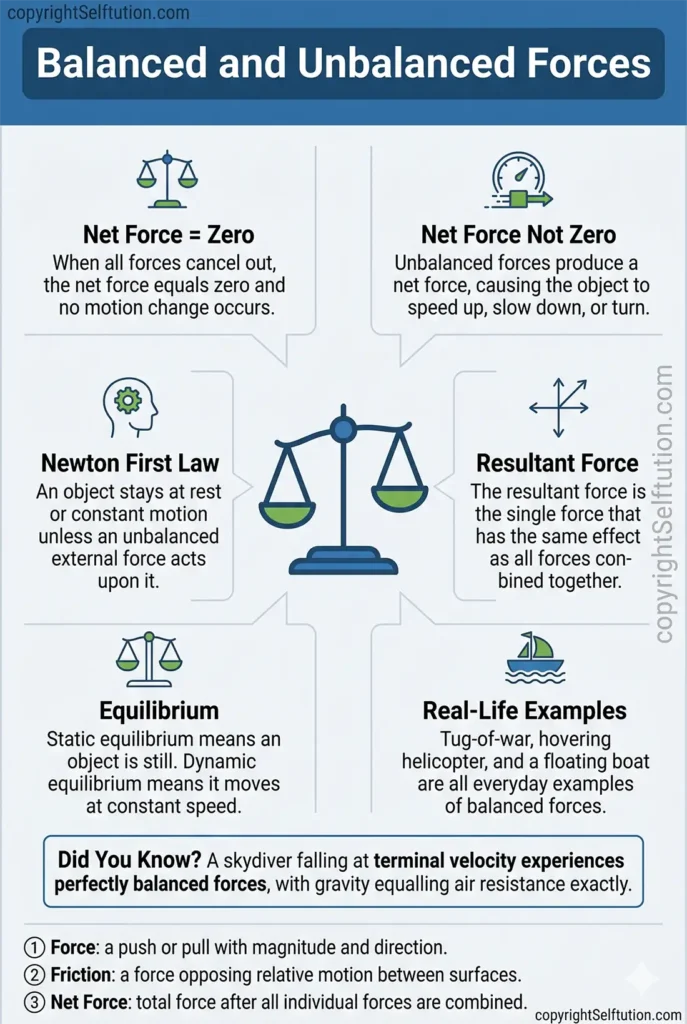
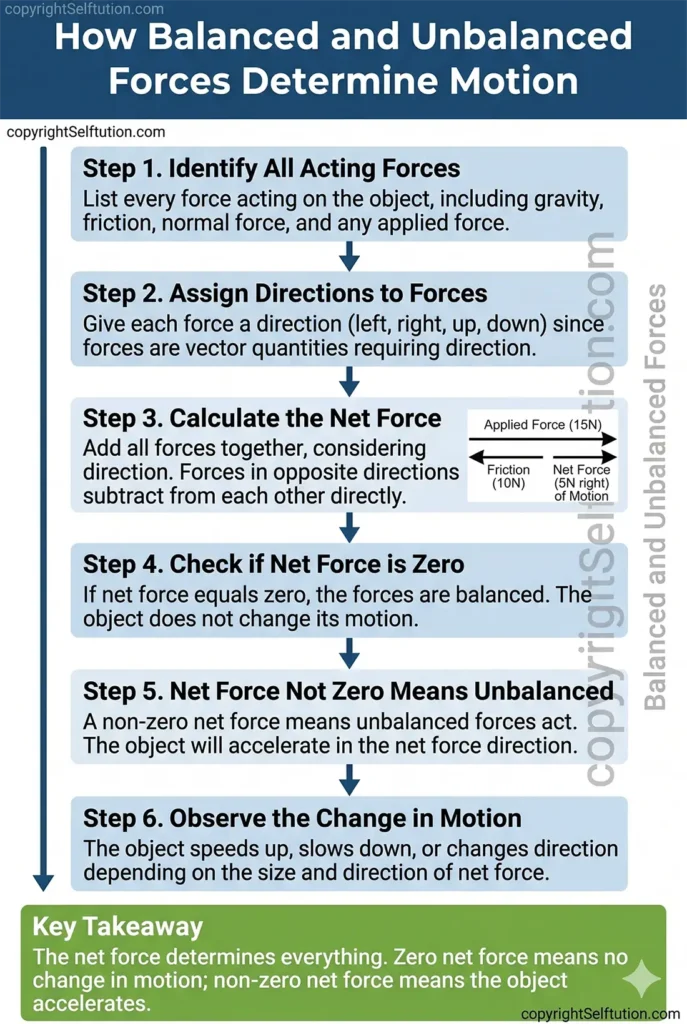
Balanced forces occur when all the forces acting on an object cancel each other out completely. As a result, the net force equals zero. When this happens, the object does not change its motion. It either stays at rest or continues moving at the same speed in the same direction.
Unbalanced forces, on the other hand, occur when the forces acting on an object do not cancel out. Therefore, the net force is not zero. Consequently, the object changes its motion. It may speed up, slow down, or change direction.
This distinction connects directly to Newton’s first law of motion, which states that an object at rest stays at rest, and an object in motion stays in motion, unless acted upon by an unbalanced force. In other words, balanced forces keep things as they are, while unbalanced forces cause change.
How to Spot Balanced Forces in Daily Life
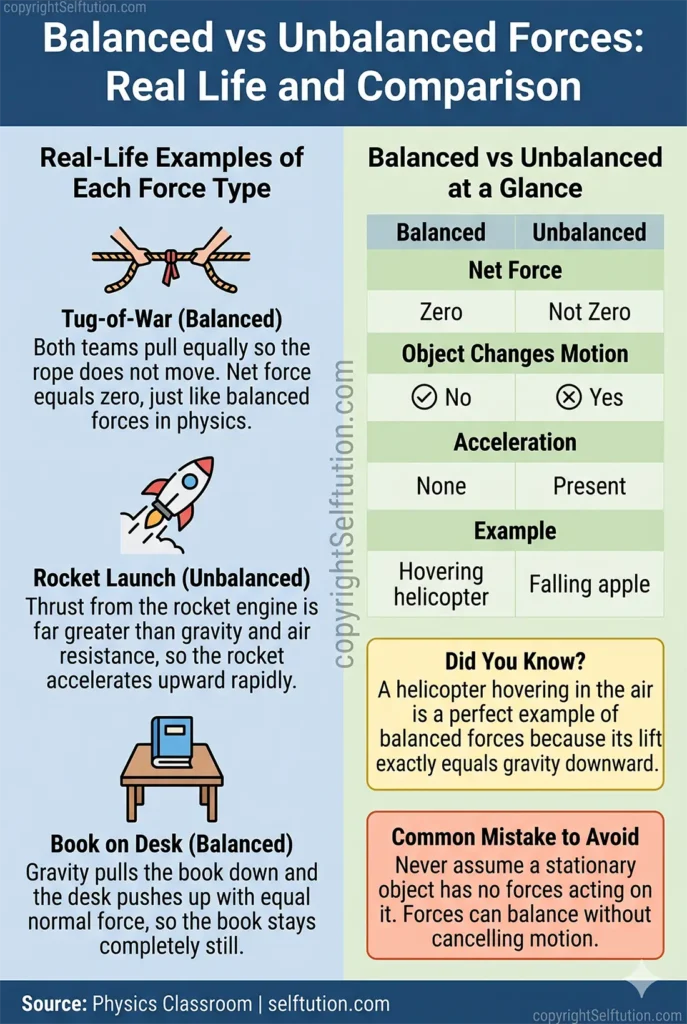
Balanced forces are everywhere around you. Consider a book resting on your desk. Gravity pulls the book downward, while the desk pushes back upward with an equal and opposite force. These two forces balance perfectly, so the book does not move. This upward push from a surface is called the normal force.
Additionally, think about a tug-of-war game where both teams pull with the same strength. Neither side moves. That is balanced and unbalanced forces in action. The rope stays still because the net force is zero.
Here are some quick examples of balanced forces:
- A picture frame hanging still on a wall (gravity down, tension up)
- A car cruising at a steady speed on a straight highway (engine force forward, friction backward)
- A swimmer floating motionless in water (weight down, buoyancy up)
How Unbalanced Forces Cause Objects to Move and Change
Unbalanced forces are responsible for every change in motion you observe. When you kick a football, your foot applies a force to the ball that is far greater than any opposing force at that instant. As a result, the ball speeds up rapidly. When the ball finally hits a wall, the wall applies a much larger force back, and the ball stops or changes direction.
However, unbalanced forces do not only speed things up. They can also slow things down. For example, friction and air resistance act on a sliding hockey puck. These forces oppose the direction of motion, so the puck gradually slows down. This is because balanced and unbalanced forces determine whether an object accelerates or decelerates.
- A rocket blasting off (thrust upward is much greater than weight downward)
- A braking bicycle (brake friction is greater than forward motion)
- A falling apple (gravity pulls it down with no equal upward force to stop it)
Balanced and Unbalanced Forces and Newton’s Laws of Motion
The concepts of balanced and unbalanced forces are closely linked to Newton’s laws of motion. Newton’s first law deals directly with balanced forces. It tells us that an object in equilibrium (net force = 0) will not change its state of motion. Newton’s second law explains what happens with unbalanced forces. It states that the acceleration of an object depends on the net force acting on it and the object’s mass. The formula is F = ma (force equals mass times acceleration).
For a deeper understanding of Newton’s laws, read our detailed guide on Newton’s laws of motion for students. You can also explore related ideas on inertia and how it relates to motion.
Equilibrium: What Happens When Forces Perfectly Balance
When balanced and unbalanced forces reach a state where the net force is exactly zero, we say an object is in equilibrium. There are two types of equilibrium worth knowing. Static equilibrium means the object is completely still. Dynamic equilibrium means the object is moving, but at a constant speed in a straight line.
For example, a skydiver reaches dynamic equilibrium when air resistance equals the pull of gravity. At that point, the skydiver falls at a constant speed called terminal velocity. This is one of the most fascinating real-world applications of balanced and unbalanced forces.
To understand how gravity fits into this picture, visit our article on gravitational force and how gravity works.
The Role of Friction in Balanced and Unbalanced Forces
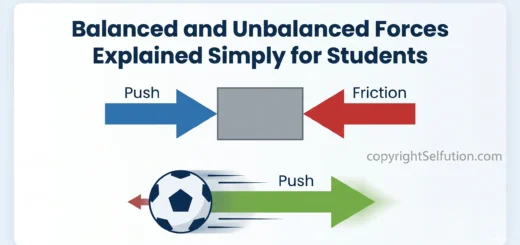
Friction plays a huge role in whether forces end up balanced or unbalanced. Friction is a force that opposes motion between two surfaces in contact. Therefore, when you push a heavy box across the floor, friction pushes back. If you push with exactly the same strength as the friction, the forces are balanced, and the box does not move. If you push harder, the forces become unbalanced and the box slides forward. Explore how friction affects forces and motion in our dedicated guide.
Additionally, static friction (the friction that prevents motion before an object starts moving) can be stronger than dynamic friction (the friction during motion). This explains why it often takes a stronger initial push to get a heavy object moving than to keep it moving once it has started.
You can learn more about the types of friction and their examples, including static, dynamic, rolling, and fluid friction, on Selftution.com.
Measuring Forces: The Role of Scalar and Vector Quantities
Because force has both magnitude and direction, it is a vector quantity. This is why balanced and unbalanced forces can only be understood by looking at both size and direction. For instance, two forces of 10 N each acting in opposite directions on an object cancel out (balanced). However, two forces of 10 N acting in the same direction add up to 20 N (unbalanced). Read our guide on the difference between scalar and vector quantities for a deeper explanation.
Real-Life Examples to Solidify Your Understanding
Let us bring these ideas to life with relatable examples you encounter every day.
Example 1: A Tug-of-War Game
When both teams pull with equal force, the rope stays still (balanced forces). When one team pulls harder, the rope moves toward them (unbalanced forces).
Example 2: A Moving Car
A car moving at constant speed on a flat road has engine thrust balanced by friction and air resistance. When the driver presses the accelerator, the engine force increases and becomes unbalanced, so the car speeds up.
Example 3: A Sinking Stone
When you drop a stone in water, gravity (downward) is greater than buoyancy (upward). As a result, the unbalanced force makes the stone sink.
You can also see balanced and unbalanced forces at work in simple machines. Explore our guide on simple machines and how forces are used in them.
Quick Summary: Key Points to Remember
- Balanced forces have a net force of zero; the object does not change its motion.
- Unbalanced forces have a non-zero net force; the object accelerates.
- Newton’s first law connects directly to balanced and unbalanced forces.
- Friction, gravity, and normal force are common forces that can be balanced or unbalanced.
- Equilibrium (static or dynamic) occurs when forces are balanced.
For further reading, explore the Physics Classroom guide on balanced and unbalanced forces and Wikipedia’s comprehensive article on force in physics.
Frequently Asked Questions About Balanced and Unbalanced Forces
What is the difference between balanced and unbalanced forces?
Balanced forces cancel each other out, resulting in a net force of zero, so the object does not change its motion. Unbalanced forces do not cancel out, so the net force is not zero, and the object changes its speed or direction.
Can an object move if only balanced forces act on it?
Yes, an object can move under balanced forces, but only at a constant speed in a straight line. It cannot speed up, slow down, or change direction while forces are balanced.
What is a real-life example of unbalanced forces?
Kicking a football is a clear example. Your kick applies a large force to the ball, while the opposing force is much smaller. As a result, the unbalanced net force causes the ball to accelerate rapidly.
How do balanced and unbalanced forces relate to Newton’s first law?
Newton’s first law states that an object will stay at rest or continue at constant velocity unless acted upon by an unbalanced force. Balanced forces maintain the current state of motion; unbalanced forces change it.
What is net force, and how does it relate to balanced and unbalanced forces?
Net force is the overall force on an object after all individual forces are added together, taking direction into account. When net force equals zero, forces are balanced. When the net force is not zero, forces are unbalanced, and the object accelerates.