Archimedes Principle or Law Explained: Why Things Float or Sink
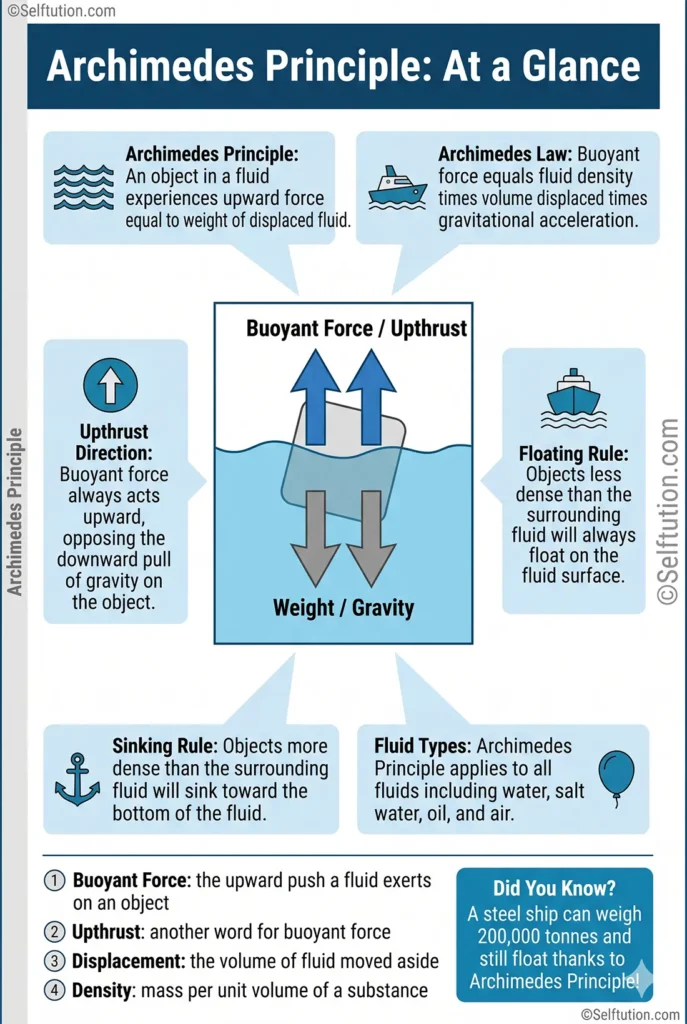
The Archimedes Principle or Law states that any object placed in a fluid experiences an upward force equal to the weight of fluid it displaces. This simple idea explains why ships float and submarines dive.
Selftution.com makes science easy and fun, offering clear, student-friendly explanations of topics like buoyancy, perfect for Grade 6 to 10 learners.
Furthermore, understanding Archimedes Law gives you a powerful tool to explain everyday events, from a rubber duck bobbing in a bathtub to a giant steel ship sailing across the ocean.
What Is the Archimedes Principle? A Simple Definition
More than 2,000 years ago, a Greek mathematician named Archimedes made a discovery that changed physics forever. According to Archimedes’ Principle, when you push an object into a liquid, the liquid pushes back with an upward force. Scientists call this upward force buoyant force or upthrust. The size of this upward push always equals the weight of the liquid that the object moves out of the way (displaces).
For example, imagine pushing a beach ball underwater. You feel a strong upward push trying to send the ball back to the surface. That push is a buoyant force at work. Additionally, this same principle governs whether objects float or sink, which is why it is one of the most important ideas in physics.
The Formula of Archimedes Law: How Scientists Calculate Upthrust
The Archimedes Law can be expressed with a straightforward formula. The buoyant force (Fb) acting on an object equals the density of the fluid (ρ) multiplied by the volume of fluid displaced (V) multiplied by gravitational acceleration (g). Written simply:
Fb = ρ × V × g
However, you do not need to memorise this formula just yet. At the Grade 6 to 10 level, the key idea is this: the more fluid an object displaces, the greater the upward push it receives. This connects directly to the concept of density, which you can explore further in Selftution’s guide on the properties of materials and substances.
Archimedes Principle and Density: The Floating vs. Sinking Rule
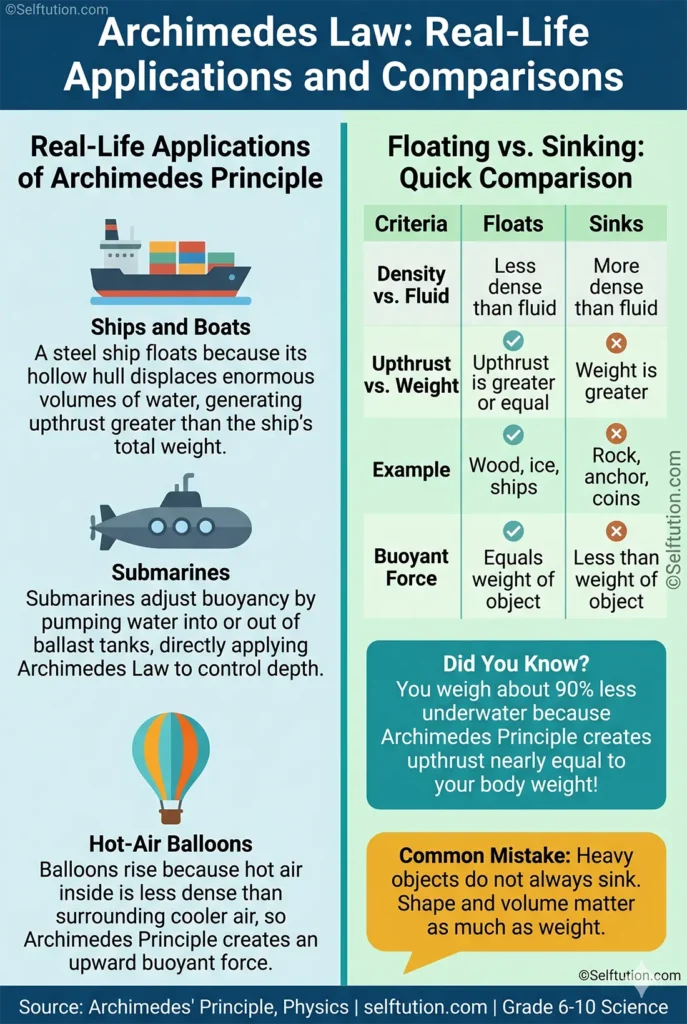
Whether something floats or sinks depends on how its density compares with the fluid it is placed in. If an object is less dense than the fluid, the buoyant force is greater than the object’s weight, and it floats. If the object is denser than the fluid, gravity wins, and the object sinks. This idea ties closely to the distinction between mass and weight, an essential concept for understanding forces in physics.
Consequently, a wooden log floats in water because wood is less dense than water. A pebble sinks because rock is denser than water. Therefore, the Archimedes Principle gives us a reliable rule for predicting floating and sinking without any complicated maths.
Everyday Examples That Bring Buoyancy to Life
One of the best things about Archimedes Law is that you can see it in action every single day. Here are some relatable examples:
- Swimming pools: When you jump into a pool, the water pushes you upward. The bigger your body volume, the greater the upthrust you feel.
- Ships and boats: Steel is denser than water, yet ships float because their hollow shape displaces a huge volume of water, creating enough upthrust to support the ship’s total weight.
- Hot-air balloons: Archimedes Principle also applies to gases. A balloon filled with hot air is less dense than the cooler air around it, so the surrounding air pushes the balloon upward.
- Submarines: Submarines control their depth by pumping water into or out of tanks, changing how much water they displace and therefore how much upthrust they receive.
- Icebergs: About 90% of an iceberg hides below the surface because ice is only slightly less dense than seawater. The Archimedes Principle determines exactly how much ice stays submerged.
Additionally, understanding these examples connects to a broader knowledge of how fluids behave. You can build on this understanding by reading about the four states of matter on Selftution.
How the Archimedes Principle or Law Works Step by Step
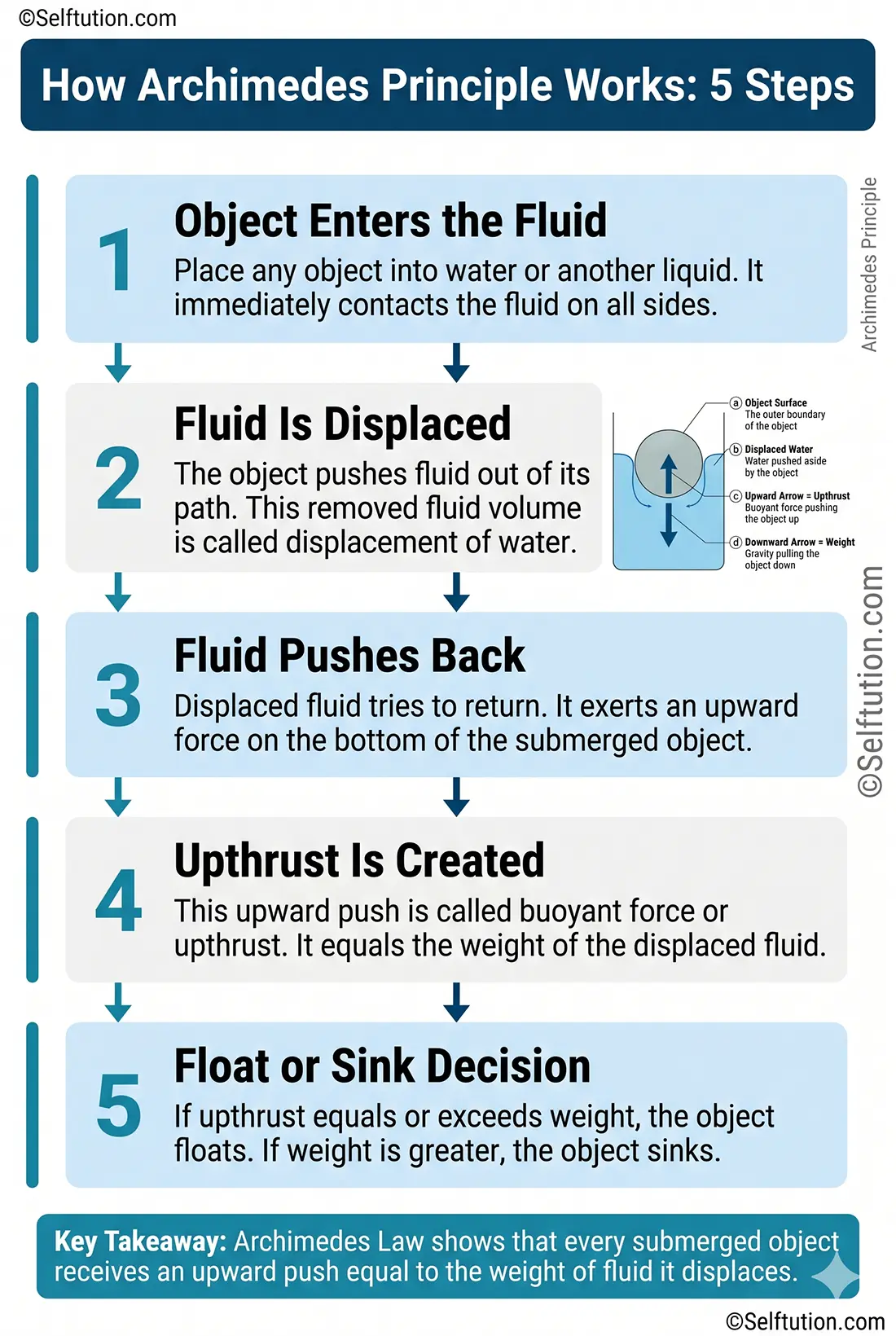
Follow these five steps to understand how upthrust acts on any object placed in a fluid:
- An object is placed into a liquid (such as water).
- The object pushes some liquid out of the way. This is called displacement of water (or fluid displacement).
- The displaced liquid tries to return to its original position and pushes back against the object.
- This push creates an upward force called buoyant force or upthrust.
- If the upthrust equals or exceeds the object’s weight, the object floats. If the object’s weight is greater, it sinks.
Furthermore, this step-by-step process connects to other physics ideas you are probably studying. For instance, it links closely to scalar and vector quantities because force has both size and direction, making it a vector.
Why Archimedes Shouted “Eureka!”: The Famous Story
According to legend, Archimedes discovered his famous principle in the bathtub. King Hiero II of Syracuse asked him to check whether his crown was made of pure gold, without damaging it. Archimedes did not know how to measure the crown’s volume until he noticed that water overflowed when he stepped into a full bath.
He realised that the volume of water spilling out equalled the volume of his body underwater. Excited by this discovery, he reportedly ran through the streets shouting “Eureka!”, which means “I have found it!” in Greek. Therefore, Archimedes Law was born from a surprisingly simple observation about water displacement.
This story is a great reminder that scientific breakthroughs often come from everyday observations. It also shows how measurement of length, mass, and temperature plays a central role in science, just as measuring the displaced water was central to Archimedes’ discovery.
Fluid Pressure and How It Creates Upthrust
To fully understand the Archimedes Principle, it helps to know a little about fluid pressure. Pressure in a fluid increases with depth, which means the bottom of a submerged object experiences greater pressure than the top. This pressure difference is precisely what creates the upward buoyant force. As a result, the deeper you go in a fluid, the stronger the pressure pushing up on any object at that depth.
This also explains why small objects submerged in shallow water experience less upthrust than large objects placed in deep water. The Archimedes Principle captures this relationship elegantly: the upthrust always equals the weight of the displaced fluid, regardless of how deep the object sits. For further reading on forces and motion, check out Selftution’s article on the difference between rest and motion.
Archimedes Principle in Science and Technology Today
The Archimedes Principle is not just ancient history. Engineers and scientists use Archimedes Law every day to design boats, submarines, aircraft, medical devices, and even space equipment.
For example, shipbuilders use buoyancy calculations to decide the ideal hull shape so that a vessel floats safely under heavy cargo loads. Medical professionals use buoyancy in devices that measure body fat by calculating how much water a patient displaces. Furthermore, researchers at NASA: Buoyancy apply buoyancy concepts to understand how objects behave in microgravity environments.
Additionally, the principle underpins our understanding of physical and chemical changes, because dissolving a substance in water changes its density, which in turn affects buoyancy. For deeper academic reading, visit Britannica: Archimedes Principle or the Wikipedia: Archimedes Principle article.
Quick Recap: Key Points to Remember
- The Archimedes Principle states that upthrust equals the weight of fluid displaced by an object.
- Archimedes Law applies to all fluids: liquids and gases alike.
- Buoyant force (upthrust) acts upward and opposes the downward pull of gravity.
- If upthrust is greater than or equal to weight, the object floats. If the weight is greater, it sinks.
- Density is the key factor: objects less dense than the fluid float; objects more dense than the fluid sink.
Frequently Asked Questions (FAQ)
Q1: What is the Archimedes Principle in simple words?
The Archimedes Principle states that any object placed in a fluid (liquid or gas) experiences an upward push called buoyant force. This push equals the weight of the fluid the object displaces. Simply put, the more fluid you push out of the way, the stronger the upward force you feel.
Q2: What is Archimedes Law and how does it differ from the Archimedes Principle?
Archimedes Law and the Archimedes Principle refer to the same scientific concept. Both describe the relationship between an object submerged in a fluid and the upward buoyant force it experiences. Some textbooks prefer one term over the other, but the meaning is identical.
Q3: Why do heavy ships float if metal is denser than water?
A ship floats because of its hollow shape. Although steel is denser than water, the ship’s hull encloses a large volume of air. This large total volume displaces enough water to generate an upthrust equal to the ship’s weight. Consequently, the Archimedes Principle allows even massive steel ships to float safely.
Q4: Does the Archimedes Principle work in all liquids?
Yes. The Archimedes Principle works in every fluid, including salt water, oil, and even gases like air. However, the buoyant force changes depending on the fluid’s density. For example, you float more easily in salty seawater than in a freshwater pool because seawater is denser and therefore produces a greater upthrust.
Q5: How can I test the Archimedes Principle at home?
Fill a bowl to the brim with water and gently place an object inside. Collect the water that overflows and measure its weight. That weight is exactly equal to the buoyant force acting on the object. This simple experiment demonstrates Archimedes Law with everyday items from your kitchen.