Nuclear Power Plant: How Does a Nuclear Power Plant Work?
At Selftution.com, we make complex science topics like this easy to understand for Grade 6 to Grade 10 students.
If you have ever wondered exactly how a nuclear power plant turns invisible atomic energy into the electricity you use to charge your phone or light your room, you are in the right place.
Let us walk through the entire process step by step, using simple language and clear examples.
What Makes a Nuclear Power Plant Different from Other Power Plants?
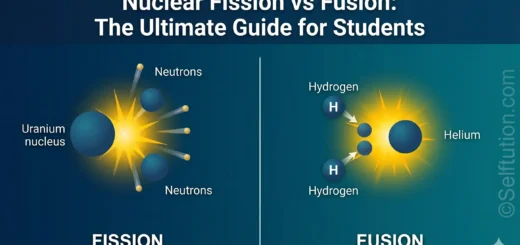
Most power plants burn coal, gas, or oil to create heat. A nuclear power plant, however, does not burn anything at all. Instead, it splits atoms of a special fuel called uranium. This splitting process is called nuclear fission (pronounced “FI-shun”), and it releases a tremendous amount of energy as heat. Furthermore, just one kilogram of uranium can produce as much energy as burning around 3,000 tonnes of coal. That is why nuclear energy is considered one of the most powerful energy sources on Earth.
Additionally, nuclear power plants produce very low carbon emissions during operation. As a result, many scientists see them as an important tool in fighting climate change. However, they also produce radioactive waste, which requires careful long-term storage. Therefore, understanding how these plants work helps you form your own informed opinion about nuclear energy.
The Fuel That Powers Everything: Uranium and Nuclear Fission
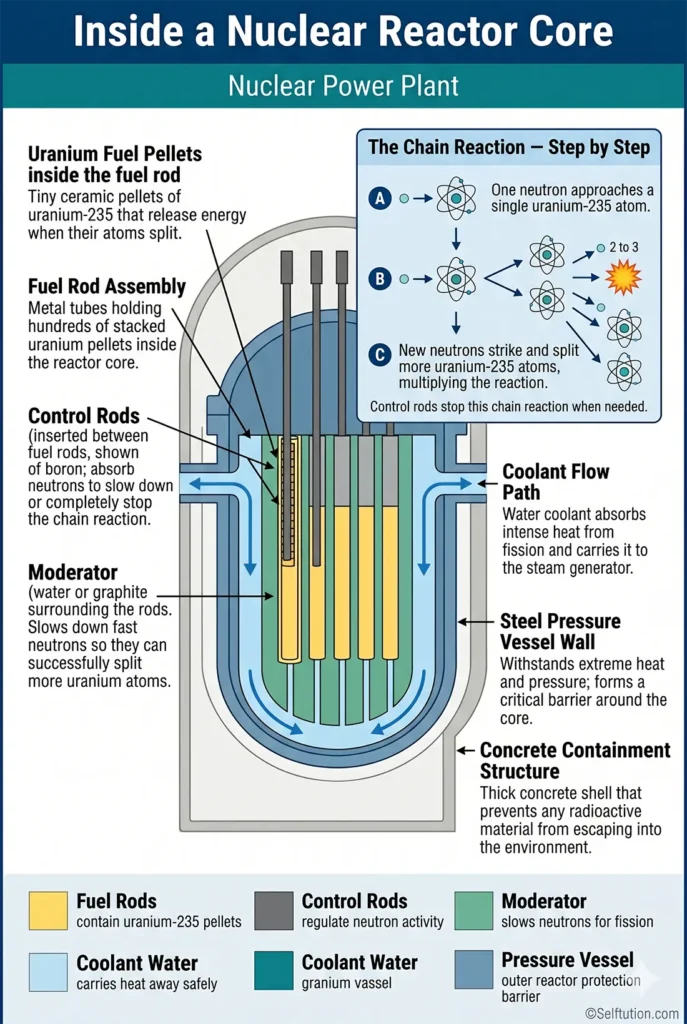
Everything inside a nuclear power plant starts with uranium fuel. Uranium is a naturally occurring metal found in rocks all around the world. Scientists process it into small ceramic pellets, each about the size of your fingertip. These pellets are loaded into long metal rods called fuel rods, which are grouped inside the reactor core. The reactor core is the heart of the entire nuclear power plant.
Inside the reactor core, neutrons (tiny particles inside atoms) strike uranium atoms at high speed. Consequently, the uranium atoms split apart, releasing heat energy and more neutrons. Those extra neutrons then strike other uranium atoms, causing a chain reaction. Control rods made of materials such as boron are inserted between the fuel rods to absorb neutrons and slow or stop the chain reaction when needed. This gives engineers precise control over how much heat the reactor produces.
From Heat to Electricity: The Journey of Energy Inside the Plant
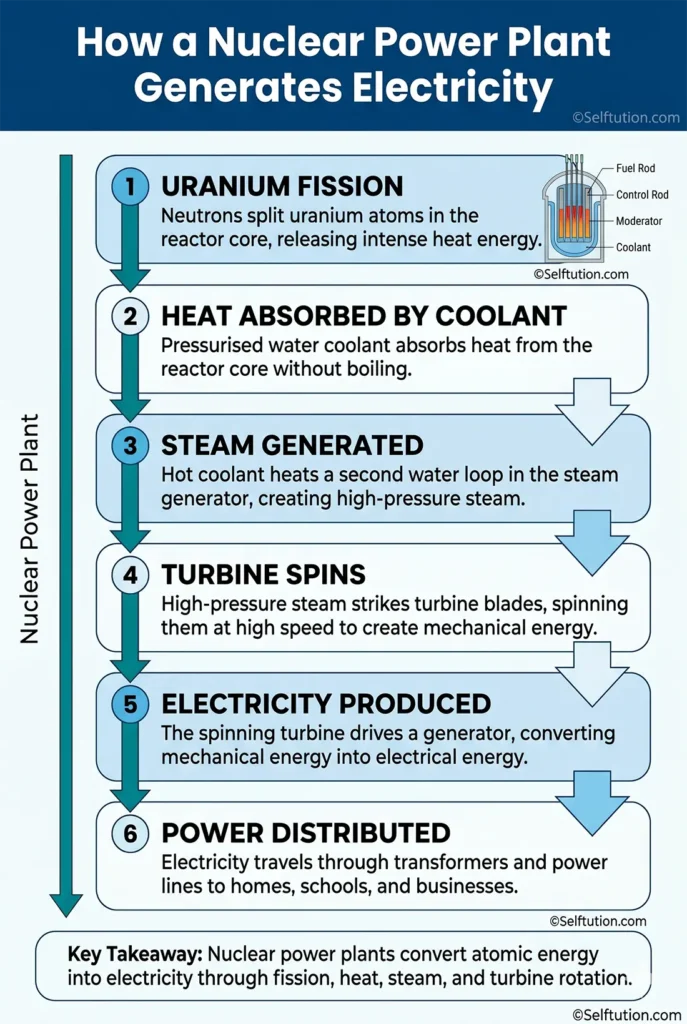
Once the reactor core generates heat, that heat must travel through several stages before it becomes electricity. Think of it like a relay race, where each stage of the nuclear power plant passes energy on to the next. Here is how it works:
First, a liquid called coolant (usually water) flows through the reactor core and absorbs the intense heat. In many designs, this water is kept under extremely high pressure so it does not boil, even at very high temperatures. This pressurised hot water then travels to a separate tank called the steam generator.
In the steam generator, the hot pressurised water heats a second loop of water, which boils and turns into steam. This steam rushes through pipes at high speed toward the steam turbine. The force of the steam spins the turbine blades very fast, just like the wind spins a pinwheel. The spinning turbine is connected to a generator, which converts that rotational movement into electrical energy. Finally, electricity travels through power lines to homes, schools, and businesses.
Key Parts of a Nuclear Power Plant and What Each One Does
Understanding the key components makes the whole system much clearer. Each part of a nuclear power plant plays a specific role:
- Reactor Core: Contains the uranium fuel rods and control rods. This is where nuclear fission happens and heat is produced.
- Coolant System: Water or another fluid that absorbs heat from the reactor core and carries it away safely.
- Steam Generator: Transfers heat from the coolant to a separate water loop, creating the steam that drives the turbine.
- Steam Turbine: Spins rapidly when high-pressure steam hits its blades, converting heat energy into mechanical energy.
- Generator: Connected to the turbine; converts spinning movement into electrical energy.
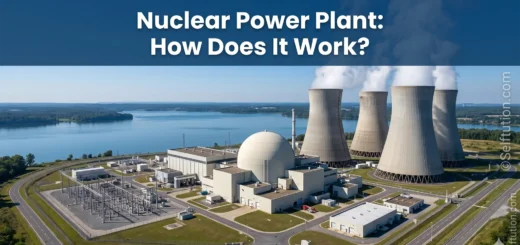
- Cooling Tower: The tall, wide structures you see in photos. They cool the used steam back into water so it can be reused.
- Containment Building: A thick concrete and steel dome surrounding the reactor. It prevents any radiation from escaping in an emergency.
To explore more about the different forms energy can take, check out Selftution’s detailed guide on types of energy in physics. Additionally, our article on nuclear fission vs fusion explains the key difference between these two powerful reactions.
Safety Inside the Plant: How Engineers Keep Everyone Protected
Safety is the top priority inside any nuclear power plant. Engineers use multiple layers of protection to make sure radioactive materials never escape into the environment. For example, the fuel pellets themselves trap most radioactive gases inside. Furthermore, the metal fuel rods form a second barrier. The thick steel pressure vessel around the reactor core provides a third barrier, and the massive concrete containment building forms a fourth.
Modern nuclear power plants also use passive safety systems that work automatically without any human action. For instance, some designs allow the reactor to cool itself using gravity and natural water flow if a power failure occurs. Consequently, these improvements make modern plants far safer than older designs. The International Atomic Energy Agency (IAEA), a United Nations organisation, sets global safety standards for all nuclear power plants. You can learn more about the IAEA at its official site, www.iaea.org.
To understand how energy is measured and converted, read our article on work and energy in physics. For a broader look at the environment and energy use, our page on environmental pollution is a helpful read.
Advantages and Challenges of Nuclear Power Plant Energy
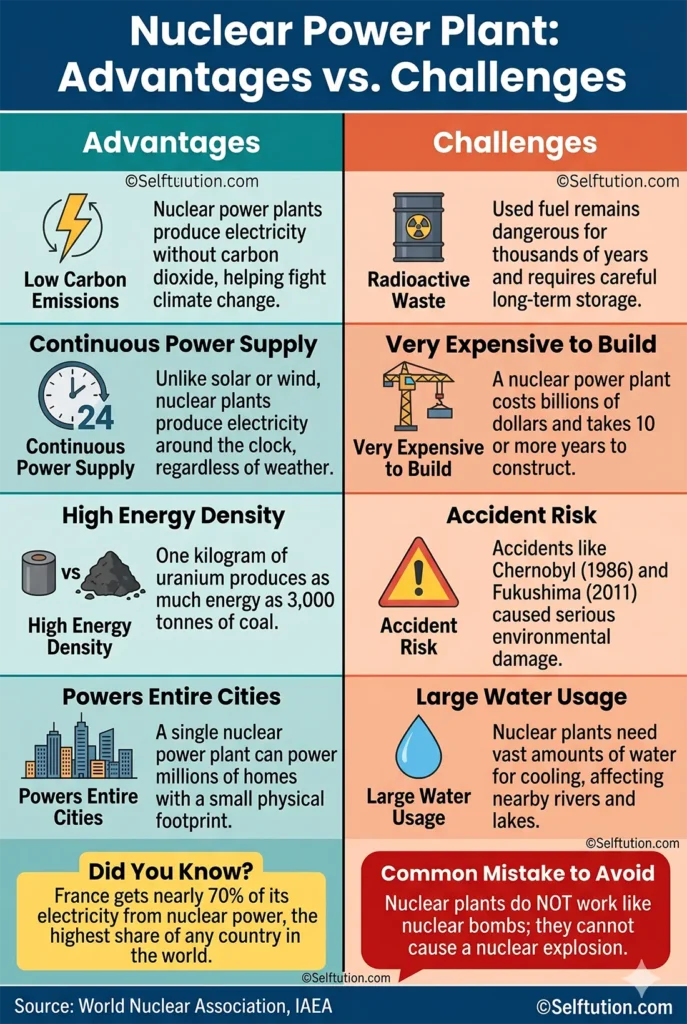
Like every energy source, a nuclear power plant has both important strengths and real challenges. Understanding both sides helps you think critically about energy choices.
On the positive side, nuclear power plants generate massive amounts of electricity without producing carbon dioxide that causes global warming. Therefore, they are one of the cleanest large-scale energy sources available today. They also operate continuously, unlike solar panels or wind turbines, which only produce power when the sun shines or the wind blows. For more on energy transformation, visit our guide on energy transformation and conservation.
However, there are challenges too. Radioactive waste from a nuclear power plant remains dangerous for thousands of years. As a result, storing it safely remains a major problem that scientists and governments continue to work on. Additionally, building a nuclear power plant is very expensive and takes many years. Accidents at plants like Chornobyl in 1986 and Fukushima in 2011 also raised serious safety concerns worldwide. Nevertheless, with modern safety improvements, many experts argue that the benefits of nuclear energy outweigh the risks.
Related reading: Learn about deforestation and its environmental effects, and explore how natural disasters can affect infrastructure, including power plants.
Where Does Nuclear Energy Fit in Our Future?
Today, around 440 nuclear power reactors operate in 32 countries, supplying about 10% of the world’s electricity, according to the World Nuclear Association. France gets nearly 70% of its power from nuclear energy. Furthermore, many countries are building new, advanced reactors that are smaller and even safer than older models.
Scientists are also working on nuclear fusion (the process that powers the sun) as a future energy source. Unlike fission, fusion does not produce long-lived radioactive waste. However, achieving practical fusion power remains a major scientific challenge. For now, fission-based nuclear power plants continue to play a vital role in global electricity production. To understand more about atomic structure and how it connects to nuclear energy, explore our article on the basic structure of the atom. You can also read more about energy on the U.S. Energy Information Administration website, and learn about global nuclear safety standards at the U.S. Nuclear Regulatory Commission’s student resources.
Frequently Asked Questions About Nuclear Power Plants
1. What does a nuclear power plant do?
A nuclear power plant generates electricity by using nuclear fission to produce heat, which turns water into steam, which then spins a turbine connected to a generator.
2. Is it safe to live near a nuclear power plant?
Modern nuclear power plants have multiple safety systems and thick protective barriers. Regulatory agencies set strict safety zones, and studies show that, under normal operation, people near plants receive very low levels of radiation. In fact, a banana contains more natural radiation than most people near a nuclear plant receive in a day.
3. What fuel does a nuclear power plant use?
Most nuclear power plants use uranium-235 as their fuel. The uranium is processed into small ceramic pellets loaded into metal fuel rods inside the reactor core.
4. How is nuclear energy different from solar or wind energy?
Nuclear energy produces electricity continuously, regardless of the weather. Solar and wind energy depend on sunlight and wind, so they can be intermittent. However, nuclear energy produces radioactive waste, while solar and wind do not.
5. Can a nuclear power plant explode like a nuclear bomb?
No. A nuclear power plant cannot explode like a nuclear bomb. The uranium fuel inside is not concentrated enough for a nuclear explosion. What can happen in a serious accident is a release of steam or heat, but not a nuclear detonation.