Centripetal vs Centrifugal Force Explained
Centripetal vs centrifugal force is one of the most misunderstood topics in physics. These two forces sound similar, but they work very differently.
Selftution.com breaks down complex science topics like this into simple, clear lessons that any student can follow, making it the perfect platform to build your physics foundation.
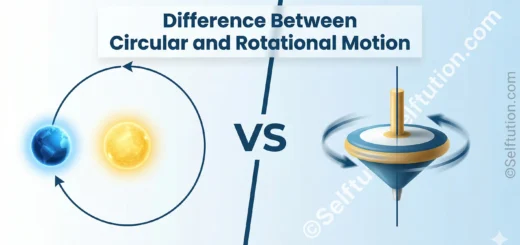
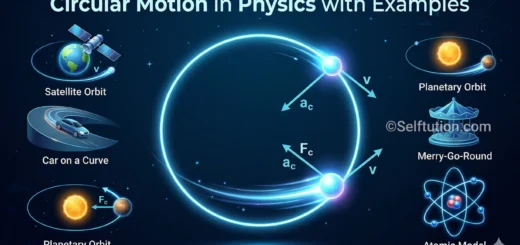
When something moves in a circle – like a spinning merry-go-round or a car turning a corner – forces are at work. Understanding centripetal vs centrifugal force helps you explain why you feel pushed outward on a ride, or why a ball on a string moves the way it does.
What Is Centripetal Force?
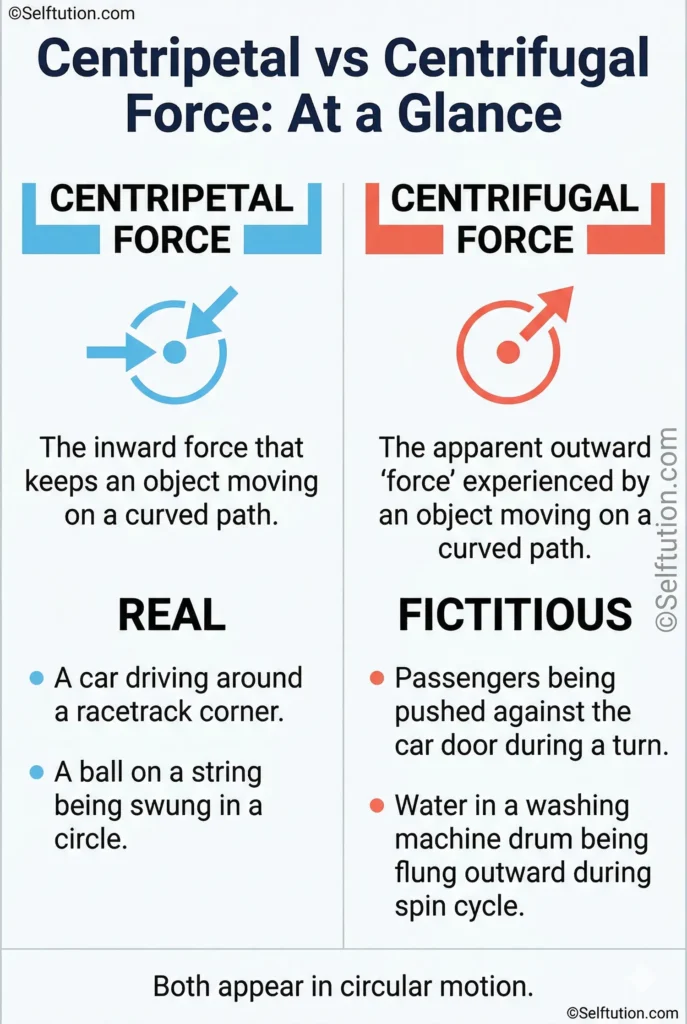
Centripetal force is the force that pulls an object toward the centre of a circular path. The word “centripetal” comes from the Latin words meaning “centre-seeking.” Therefore, whenever an object travels in a circle, the centripetal force is what keeps it from flying off in a straight line.
For example, imagine swinging a ball attached to a string above your head. The string pulls the ball inward – toward your hand – and that pull is centripetal force. Without it, the ball would fly outward the moment you let go.
Additionally, centripetal force is not a separate, special force in its own. It is the name we give to whatever real force – gravity, tension, friction – is doing the job of pulling inward. For instance, the Moon stays in orbit around the Earth because gravity acts as the centripetal force.
You can learn more about how forces like gravity work at Selftution’s guide on gravitational force and how objects in motion behave in types of motion in physics.
Centripetal vs centrifugal force
What Is Centrifugal Force?
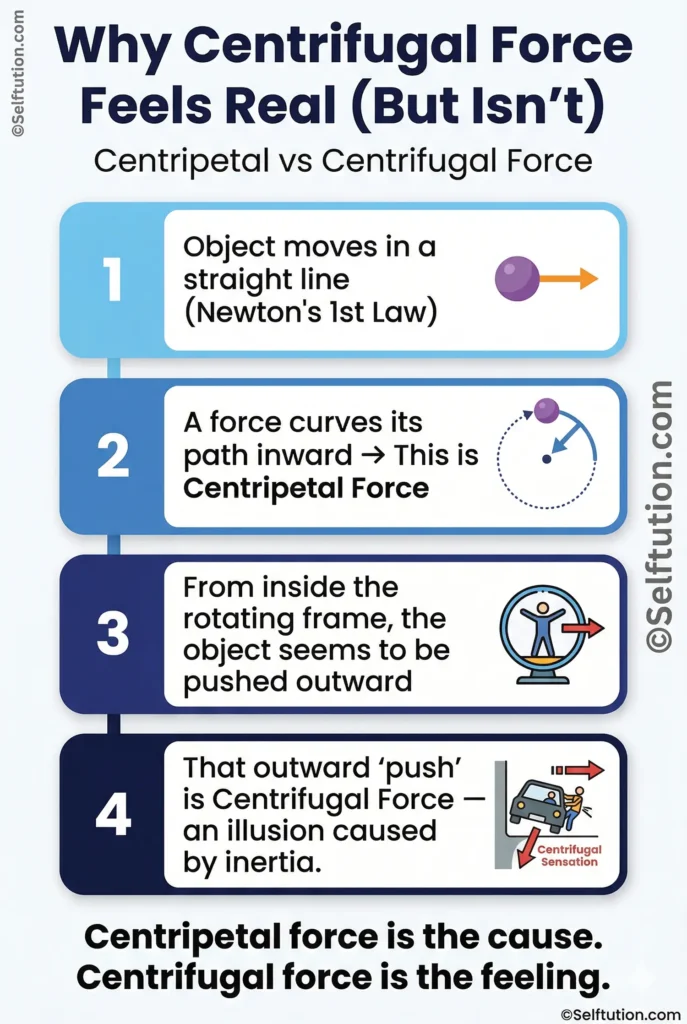
Centrifugal force is very different from centripetal force – and here is the surprising part: centrifugal force is not a real force at all. Scientists call it a “fictitious force” or a “pseudo-force.” However, it feels very real when you experience it.
When you sit in a car that takes a sharp turn, you feel pushed toward the outside of the turn. That outward push is what people call centrifugal force. Consequently, your body wants to keep moving in a straight line – which is inertia – but the car curves around you. The result is that you feel pressed against the door.
Furthermore, centrifugal force only appears to exist when you are inside the rotating system itself. If someone watches you from outside the car, they do not see any outward force – they only see your body trying to continue in a straight line while the car turns.
To understand why objects resist changes in motion, read Selftution’s explanation of what inertia is and Newton’s Laws of Motion.
Centripetal vs Centrifugal Force: The Key Differences
Understanding centripetal vs centrifugal force becomes easier when you compare them side by side.
- Direction: Centripetal force always points inward, toward the centre of the circle. Centrifugal force appears to push outward, away from the centre.
- Reality: Centripetal force is a real force – it is physically measurable. Centrifugal force is a fictitious force – it is a sensation caused by inertia, not an actual push.
- Observer: Centripetal force exists for all observers. Centrifugal force is only felt by someone inside the rotating system.
- Examples: Gravity keeps a satellite in orbit (centripetal) vs. the feeling of being pushed against your seat on a roller coaster (centrifugal).
Therefore, the simplest way to remember the difference is: centripetal pulls in, centrifugal seems to push out — but only one of them is truly real.
Centripetal vs centrifugal force mechanism
Real-Life Examples of Centripetal vs Centrifugal Force That Make It Click
Real-life examples of centripetal vs centrifugal force are everywhere around you, and recognising them makes physics much more fun.
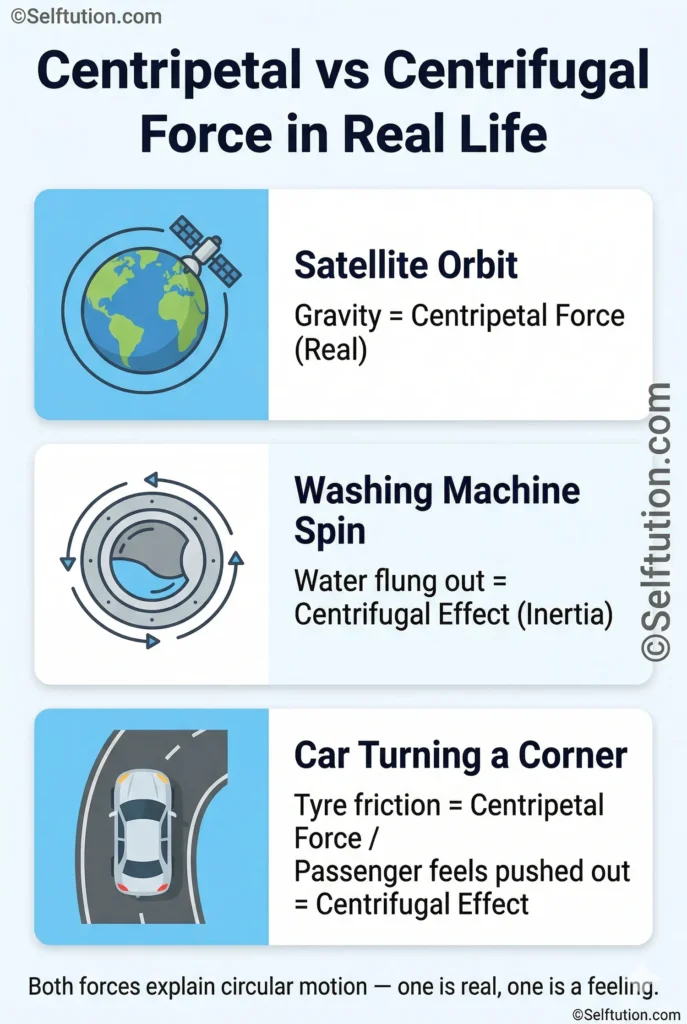
Washing machine spin cycle: As the drum spins, water is flung outward through tiny holes – this is the effect of centrifugal force (inertia in action). However, the drum walls provide centripetal force that keeps the clothes moving in a circle.
Planets orbiting the Sun: Gravity acts as the centripetal force that keeps each planet on its curved path. Without gravity pulling inward, planets would shoot off into space in a straight line.
A car turning a corner: Friction between the tyres and the road provides centripetal force to turn the car. Meanwhile, passengers feel pushed outward – the familiar sensation of centrifugal force.
For more on how objects move and interact, explore Selftution’s posts on scalar and vector quantities, translatory motion, and different forms of energy.
The Formula for Centripetal Force
Physics gets more powerful when you add numbers to it. The formula for centripetal force is:
F = mv² / r
- F = centripetal force (in Newtons)
- m = mass of the object (in kilograms)
- v = speed of the object (in metres per second)
- r = radius of the circular path (in metres)
For example, if a 2 kg ball moves in a circle of radius 0.5 m at a speed of 3 m/s, the centripetal force equals 2 × 9 / 0.5 = 36 Newtons pulling it inward. Notice that centrifugal force has no separate formula – it equals the centripetal force in magnitude but acts in the opposite direction, and only appears from inside the rotating frame.
Why Do Centripetal and Centrifugal Forces Matter in the Real World?
Understanding centripetal vs centrifugal force is not just for exams – engineers and scientists use these concepts every day. For instance, roller coaster designers calculate centripetal force to ensure riders stay safely on the track at the top of a loop. Similarly, space agencies use centripetal motion to precisely plan satellite orbits.
Additionally, centrifuges – machines used in hospitals and laboratories – spin samples at very high speeds. The centrifugal effect (inertia) separates materials of different densities, helping doctors analyse blood or scientists purify chemicals.
You can deepen your understanding of related forces by reading about friction forces and work and energy in physics on Selftution.
Centripetal vs centrifugal force: Examples
Frequently Asked Questions About Centripetal vs Centrifugal Force
Is centrifugal force real or fake?
Centrifugal force is considered a fictitious or pseudo-force. An actual push does not cause it – instead, it is the sensation of inertia when your body tries to continue moving in a straight line while a rotating system curves around you.
What provides centripetal force in everyday life?
Different forces act as centripetal forces in different situations. Gravity keeps planets and satellites in orbit. Friction keeps cars on curved roads. Tension in a string keeps a spinning ball on its path.
Can centripetal and centrifugal force cancel each other out?
No. Centripetal force is real and measurable. Centrifugal force is fictitious – it only appears in a rotating frame of reference. They cannot cancel each other because they do not both exist in the same frame at the same time.
Why do we feel pushed outward on a merry-go-round?
Your body has inertia – it wants to keep moving in a straight line. As the merry-go-round rotates, it curves your path. Consequently, you feel an apparent outward push, which is the centrifugal effect.
What is the difference between centripetal acceleration and centripetal force?
Centripetal acceleration is the rate at which an object’s velocity direction changes as it moves in a circle (a = v²/r). Centripetal force is the force that causes this acceleration (F = ma). They are related but not the same thing.
You may also like…... Types of Chemical Reactions in Chemistry