Translatory Motion: Linear, Rectilinear and Curvilinear Motions
Understand Translatory Motion: Master the differences between Linear, Rectilinear, and Curvilinear motion with clear definitions, real-world examples, and simple diagrams.
Selftution.com breaks down complex physics concepts into easy-to-learn segments.
So, let’s begin.
When we look around in our daily lives, we see different objects in motion.
A car moving on the road, a ball rolling on the ground, or a train running on tracks – all these are examples of motion.
But motion can happen in many forms. One of the most basic types of motion is Translatory Motion.
In this blog, we will explore the meaning of translatory motion, its types, like Rectilinear Motion and Curvilinear Motion, and how it is different from other types of motion.
We will also connect this topic to other types of motion so that you can build a complete picture of how things move in our world.
To understand the difference between the rest and the motion, click here.
What is Translatory Motion?
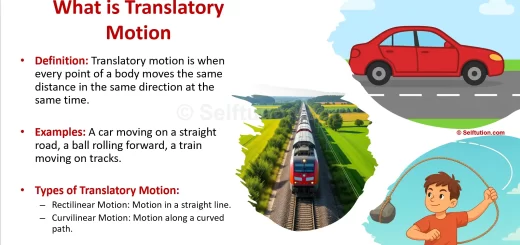
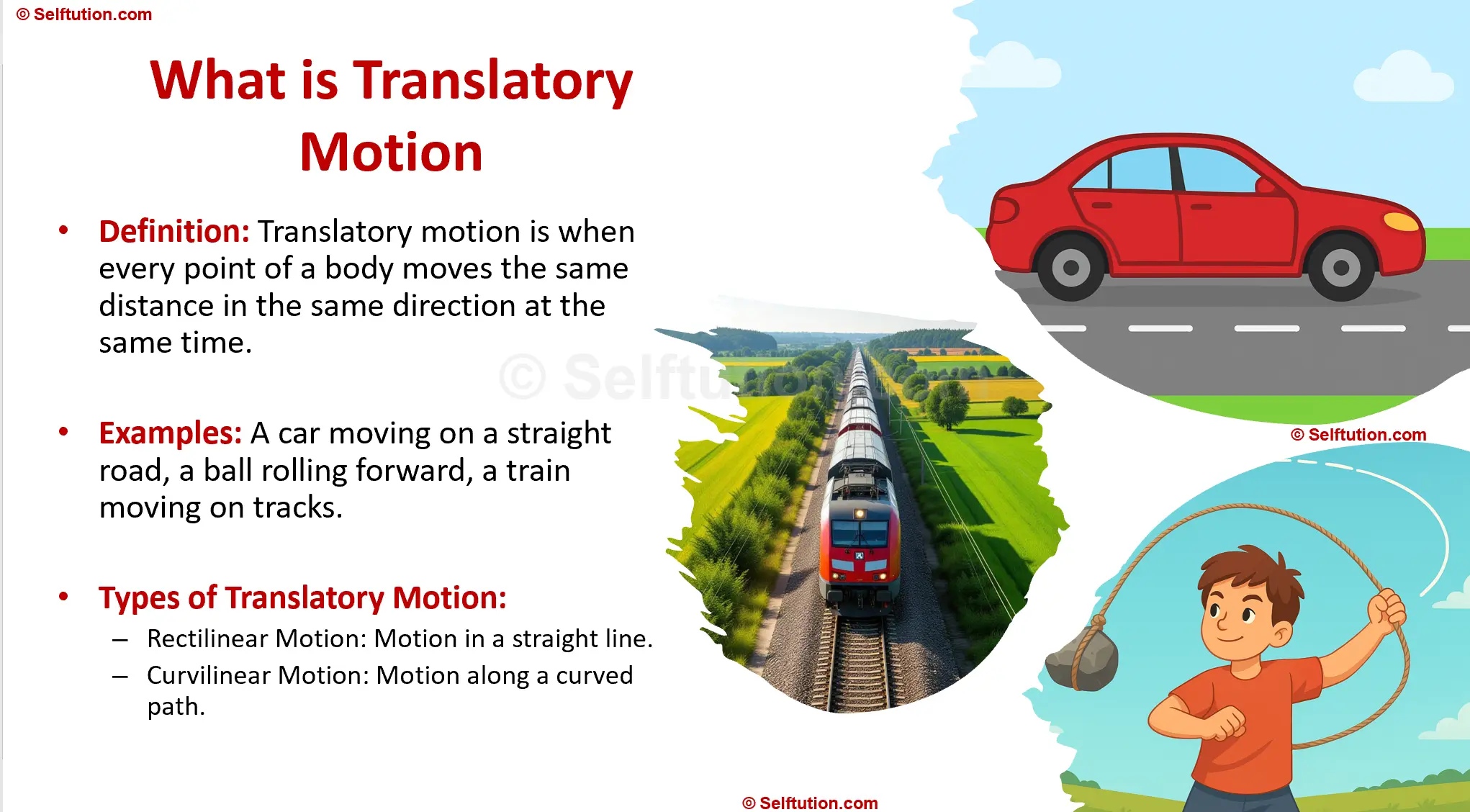
Translatory motion is the motion in which every point of a body moves the same distance in the same direction at the same time. In other words, if you observe any two points on the body, they cover equal distances in equal intervals of time.
For example:
- A moving car on a straight road.
- A train running on tracks.
- A boy walking forward.
In all these cases, the entire body is moving together in one direction without rotating or spinning. That’s why this type of motion is called translatory motion.
Everyday Examples of Translatory Motion
To understand it better, let us look at a few simple examples:
- A person sliding down a playground slide.
- A book is being pushed across the table.
- A bus is moving on a highway.
- A ship sailing in the sea.
In all these cases, the objects move from one place to another in a straight or curved path.
Types of Translatory Motion
It is broadly divided into two main types:
- Rectilinear Motion
- Curvilinear Motion
Let us study each in detail.
Rectilinear Motion
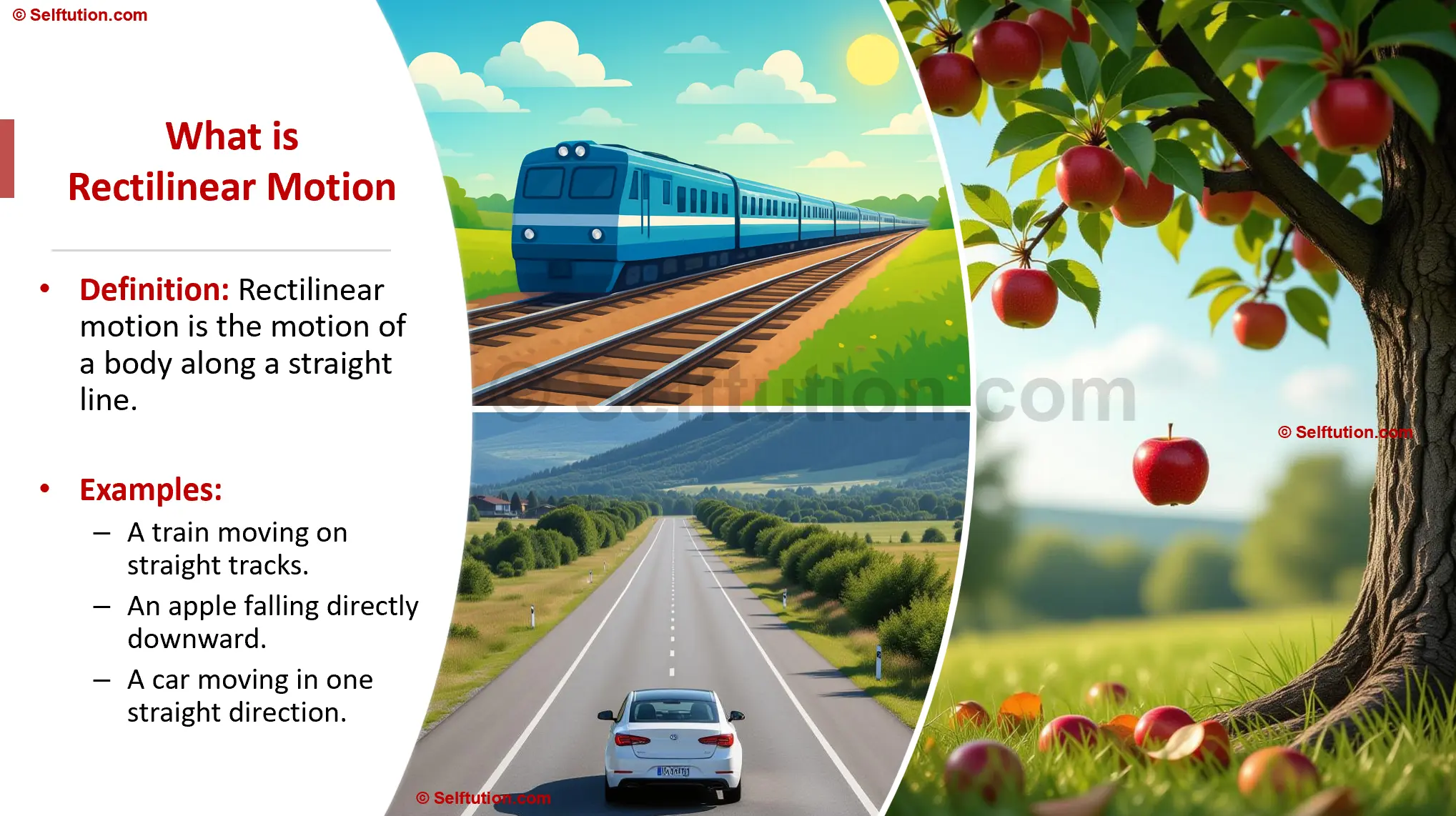
Rectilinear motion is when an object moves along a straight line. In this type of motion, the direction does not change.
Examples:
- A train moving on straight tracks.
- A ball falling directly downward due to gravity.
- A car moving in one straight direction on a road.
Key features of rectilinear motion:
- The path is always straight.
- The object does not rotate.
- All points on the object move equally in the same line.
Rectilinear motion is the simplest and most commonly seen type of translatory motion.
What is Rectilinear Motion with Examples
Curvilinear Motion
Curvilinear motion happens when an object moves along a curved path. Unlike rectilinear motion, the direction of the object keeps changing.
Examples:
- A ball thrown in the air at an angle (projectile motion).
- A car taking a turn on a curved road.
- A stone tied to a rope and swung in a circle.
Key features of curvilinear motion:
- The path is curved, not straight.
- The object still does not rotate about its own axis – it only translates.
- Every point of the object covers the same distance along the curve.
Curvilinear motion is very common in sports, for example, when a cricket ball is bowled or when a football is kicked at an angle.
Translatory Motion vs Rotatory Motion
To understand translatory motion better, it is useful to compare it with rotatory motion.
- In translatory motion, all parts of the body move in the same direction and cover equal distances.
- In rotatory motion, the body spins around a fixed axis. For example, the spinning of a top or the rotation of a fan blade.
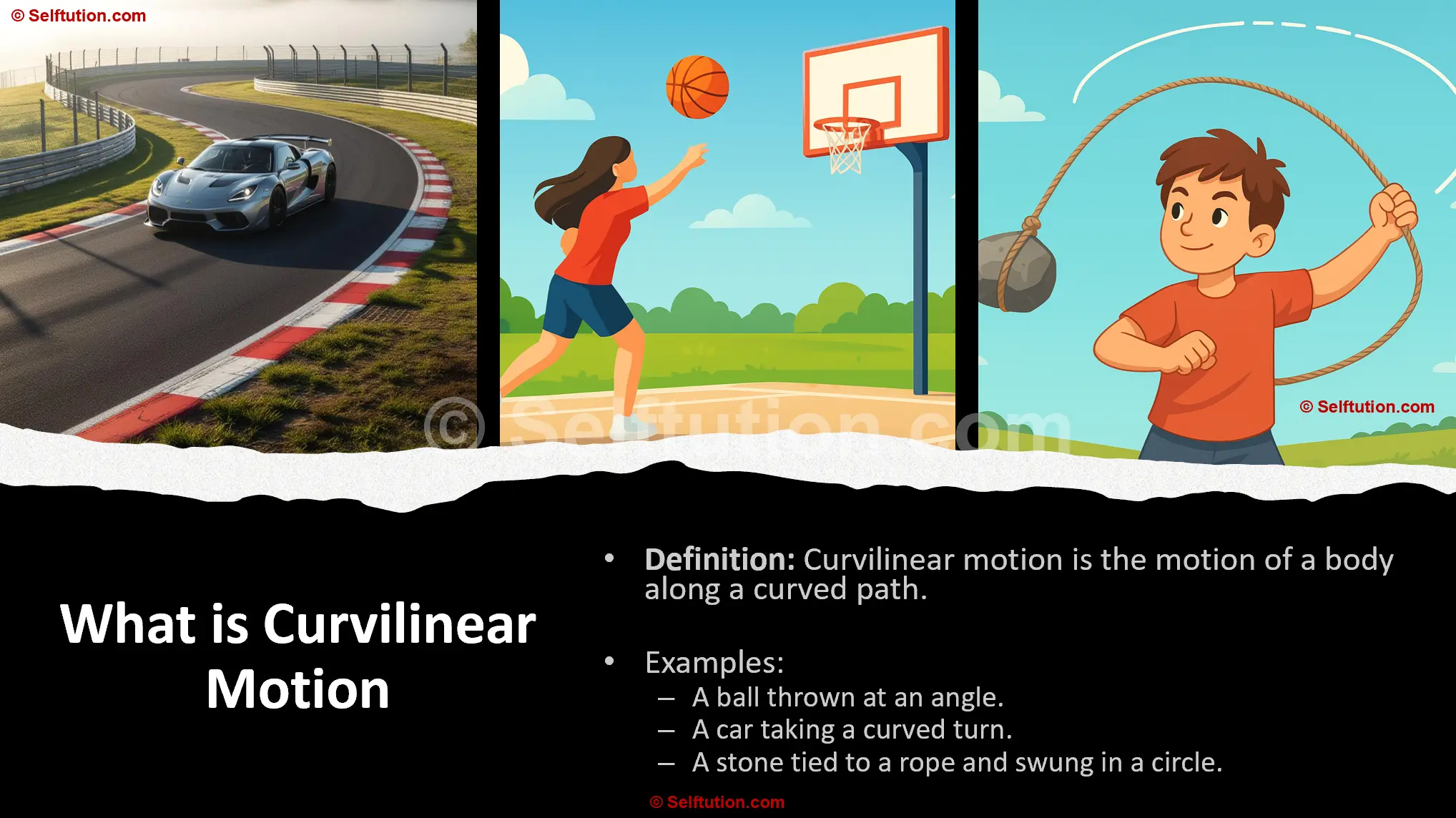
What is Curvilinear Motion with Examples
Translatory Motion and Linear Motion
Sometimes, people use the term linear motion instead of rectilinear motion. Linear motion is basically the motion of an object along a line, and that line can be straight or curved.
So:
- If the line is straight → it is rectilinear motion.
- If the line is curved → it is curvilinear motion.
This means linear motion is a broader term that includes both rectilinear and curvilinear motion.
Importance of Studying Translatory Motion
Why should we study translatory motion? Here are some reasons:
- Real-life Applications: Cars, trains, airplanes, and even people move with translatory motion.
- Foundation for Physics: Understanding it helps in learning advanced topics like Newton’s Laws of Motion.
- Engineering and Design: Machines and vehicles are designed keeping this type of motion in mind.
Translatory Motion in Nature
We don’t just see this motion in man-made objects. It also exists in nature.
Examples:
- Water flowing in a river.
- Animals walking or running.
- A leaf falling from a tree.
Difference Between Rectilinear Motion and Curvilinear Motion

Rectilinear vs Curvilinear Motion
Bridging to Other Types of Motion
So far, we have studied translatory motion and its types. But motion can also be of other kinds, such as:
- Rotatory Motion: When a body spins around a fixed axis, like the Earth rotating on its axis.
- Oscillatory Motion: When a body moves back and forth repeatedly, like a pendulum.
- Periodic Motion: Motion that repeats after equal intervals of time.
These other types of motion are also important in physics. If you want to understand the complete picture of motion, you must connect translatory motion with it.
For example:
- A wheel of a moving car shows rotatory motion, but the car itself shows translatory motion.
- A swing in a park shows oscillatory motion, but if you push the swing forward, the whole swing also shows translatory motion.
This connection between different types of motion makes the topic more interesting and practical.
Quick Recap
- Translatory motion is when every point of a body moves the same distance in the same direction.
- It has two types: Rectilinear Motion (straight path) and Curvilinear Motion (curved path).
- Linear motion is a general term that includes both rectilinear and curvilinear motion.
- Translatory motion is different from rotatory motion.
- It is seen everywhere in daily life and in nature.
Conclusion
Translatory motion is one of the most fundamental concepts in physics. It helps us understand how objects move from one place to another. By learning about rectilinear motion, curvilinear motion, and linear motion, we get a clear picture of how motion works in both simple and complex systems.
But this is just the beginning. Motion is a vast topic, and translatory motion connects to many other types of motion, like rotatory, oscillatory, and periodic motion. Exploring these connections will not only strengthen your understanding of physics but also make you curious about the world around you.
If you enjoyed learning here, you may also like to explore our upcoming blogs on rotatory motion, oscillatory motion, and periodic motion. Together, they form the complete study of motion.
You may also like…... Types of Chemical Reactions in Chemistry