Moment of Inertia: Formula and Parallel Axis Theorem
Master the Moment of Inertia – Formulas, Parallel Axis Theorem & Step-by-Step Examples
Unlock the secrets of rotational motion with Selftution.com – the best educational website for clear, simplified engineering and physics concepts.
In this guide, you’ll learn:
✔ What is Moment of Inertia? – Definition & key formulas.
✔ Parallel Axis Theorem Explained – Derivation & practical applications.
✔ Solved Examples – Real-world problems with step-by-step solutions.
Welcome to Selftution.com, where complex theories become easy to grasp!
Moment of inertia is a key concept in physics that explains how objects resist rotational motion.
Ever tried opening a stiff door by pushing near the hinges? Not very effective, right? But push it from the edge, and it swings open easily.
That’s because of something called the moment of inertia, also known as rotational inertia or angular inertia.
If you’re trying to understand what moment of inertia means, how to calculate it, and how the Parallel Axis Theorem helps shift your reference point, you’re in the right place.
We’re going to break it all down in plain English – no jargon, no dry lectures.
What Is Moment of Inertia (MI) in Physics?
The moment of inertia is like the rotational cousin of mass.
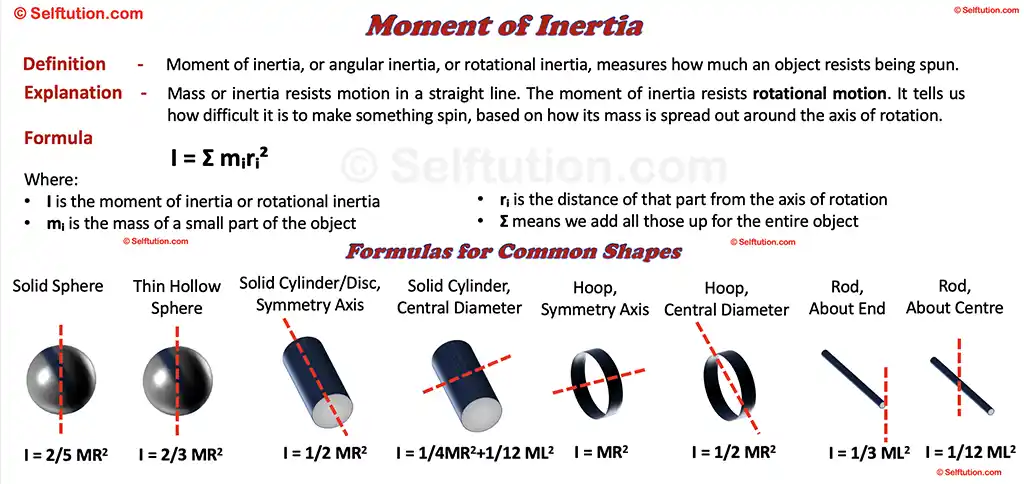
Mass or inertia resists motion in a straight line. The moment of inertia resists rotational motion. It tells us how difficult it is to make something spin, based on how its mass is spread out around the axis of rotation.
Imagine two objects with the same mass: a solid disc and a ring. Try spinning both, same mass, but different feel. The ring is harder to spin because its mass is farther from the center. That’s the higher angular or rotational inertia.
So in simple terms:
Moment of inertia, or angular inertia, or rotational inertia, measures how much an object resists being spun.
Master the Moment of Inertia – Formulas for Common Shapes & Step-by-Step Examples
Why Moment of Inertia (MI) Matters in Real Life
Even if you’re not building satellites or roller coasters, the concept of MI shows up everywhere:
- In car engines and braking systems
- When a figure skater pulls in her arms to spin faster
- In the motion of drones, robots, or mechanical arms
- Even in sports like diving, gymnastics, and skateboarding
And if you’re a student, well, this is a physics staple. Mastering it helps you tackle a lot of rotational motion problems.
Moment of Inertia Formula: The Basics
Let’s get to the heart of the concept. The basic moment of inertia formula is:
I = Σ mᵢrᵢ²
Let’s break that down:
- I is the MI or rotational inertia
- mᵢ is the mass of a small part of the object
- rᵢ is the distance of that part from the axis of rotation
- Σ means we add all those up for the entire object
In short, we multiply each bit of mass by the square of its distance from the axis and sum everything. That gives the total rotational inertia.
For continuous objects, we use integrals instead of summations. But the concept stays the same.
Moment of Inertia Formulas for Common Shapes
Different shapes distribute their mass differently, so they each have unique moment of inertia formulas. Here’s a quick reference:
- Solid disc or cylinder (about the central axis):
I = (1/2)MR² - Hollow cylinder (thin ring):
I = MR² - Solid sphere (through center):
I = (2/5)MR² - Thin rod (through center, perpendicular to length):
I = (1/12)ML² - Thin rod (about one end):
I = (1/3)ML²
The key trend? The further the mass is from the rotation axis, the higher the rotational inertia.
Parallel Axis Theorem to Calculate Moment of Inertia
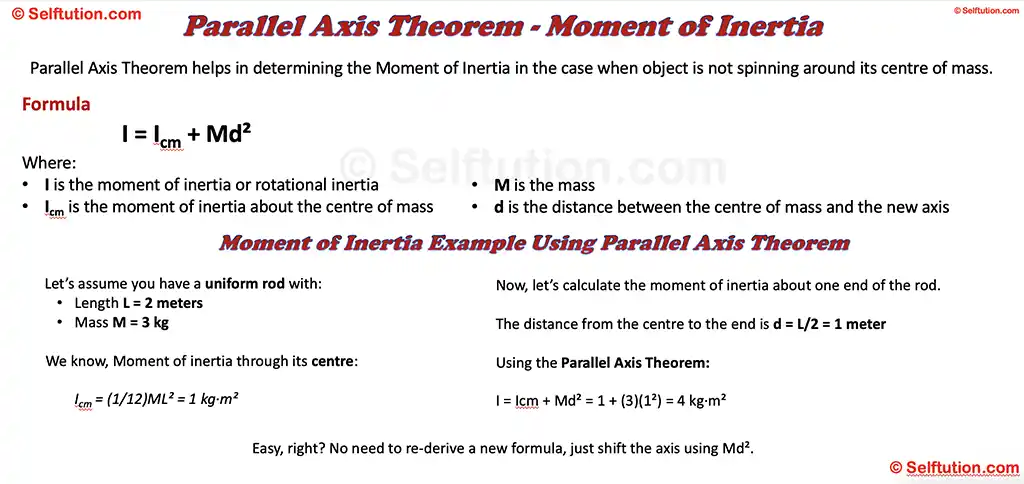
Here’s the deal: most formulas above assume the object is spinning around its center of mass. But in real life, we often rotate objects around a different axis, like the end of a rod or the edge of a disc.
This is where the Parallel Axis Theorem becomes super useful.
The Parallel Axis Theorem Formula
I = Icm + Md²
Where:
- I is the MI about the new axis
- Icm is the MI about the center of mass
- M is the mass
- d is the distance between the center of mass and the new axis
This theorem lets you shift your rotation axis and still calculate the moment of inertia without starting over from scratch.
Moment of Inertia – Formulas, Parallel Axis Theorem & Step-by-Step Examples
Moment of Inertia Example Using Parallel Axis Theorem
Let’s work through a real example.
You have a uniform rod with:
- Length L = 2 meters
- Mass M = 3 kg
From earlier, we know:
- MI through its center:
Icm = (1/12)ML² = 1 kg·m²
Now, let’s calculate the moment of inertia about one end of the rod.
The distance from the center to the end is d = L/2 = 1 meter
Using the Parallel Axis Theorem:
I = Icm + Md² = 1 + (3)(1²) = 4 kg·m²
Easy, right? No need to re-derive a new formula, just shift the axis using Md².
Why the Parallel Axis Theorem Simplifies Moment of Inertia Calculations
This theorem is a time-saver, especially in:
- Engineering (where rotating parts aren’t always centered)
- Physics problems (especially on tests)
- Robotics and mechanical systems (think arms and joints)
- Animation and game physics (for realistic movement)
It’s like having a shortcut for recalculating the moment of inertia when your axis of rotation shifts.
The Perpendicular Axis Theorem for 2D Objects
There’s also the Perpendicular Axis Theorem, which helps with flat 2D shapes like plates and discs.
The Formula:
Iz = Ix + Iy
Here’s what that means:
- Iz is a MI through the center, perpendicular to the plane
- Ix and Iy are through the center in the plane (horizontal and vertical axes)
You mostly use this one for shapes that lie flat, useful in structural mechanics and dynamics.
Common Mistakes When Learning Moment of Inertia
Here are a few things to avoid:
- Forgetting the square in r²
That little square matters a lot. Doubling the distance quadruples the moment of inertia.
- Thinking mass is all that matters
It’s not just how much mass there is, it’s how far from the axis it’s placed.
- Using the wrong axis
If the axis isn’t at the center, use the Parallel Axis Theorem. Don’t just copy-paste the central formula.
- Mixing up formulas for different shapes
Every shape has its own moment of inertia formula. A ring and a disc aren’t the same.
Final Thoughts:
Let’s bring it all together:
- Moment of inertia is a measure of how hard it is to rotate an object.
- It depends on both mass and how that mass is distributed around the rotation axis.
- I = Σ mᵢrᵢ² is the foundation for all moment of inertia calculations.
- The Parallel Axis Theorem lets you shift the axis without recalculating everything.
- The Perpendicular Axis Theorem helps when working with flat shapes.
In short, the MI helps explain how the world spins—from doors to drones, from gymnasts to gears.
Once you start seeing it in everyday life, physics becomes a little less about formulas and a lot more about intuition.
You may also like…... Types of Chemical Reactions in Chemistry