Longitudinal vs Transverse Waves: The Ultimate Guide for Students
Longitudinal vs transverse waves represent two fundamental types of wave motion in physics. Understanding them unlocks how sound, light, and energy travel through the world around you.
At Selftution.com, our step-by-step guides make understanding complex physics topics like wave motion easy and enjoyable for every student.
What Makes a Wave? The Surprising Science of Energy Travel
Before comparing the two types, it helps to understand what a wave actually is. A wave is a disturbance that transfers energy from one place to another without moving matter permanently. For example, when you drop a stone into water, ripples spread outward. The water itself does not travel to the shore. Instead, energy moves through it.
All waves need a medium to travel through, except for electromagnetic waves like light. Waves that require a medium are called mechanical waves. Furthermore, every wave has key properties: wavelength, frequency, amplitude, and speed. These properties apply to both longitudinal and transverse waves, so understanding them gives you a solid foundation.
Longitudinal vs Transverse Waves: What Are They and How Do They Differ?
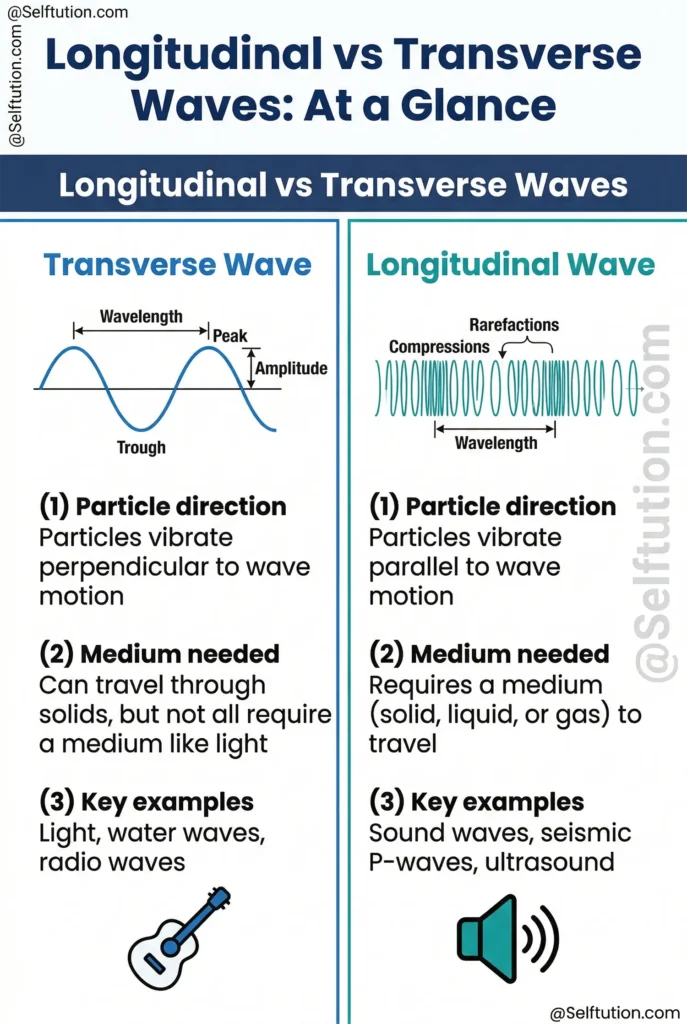
The key difference between longitudinal vs transverse waves lies in the direction of particle movement relative to the direction the wave travels.
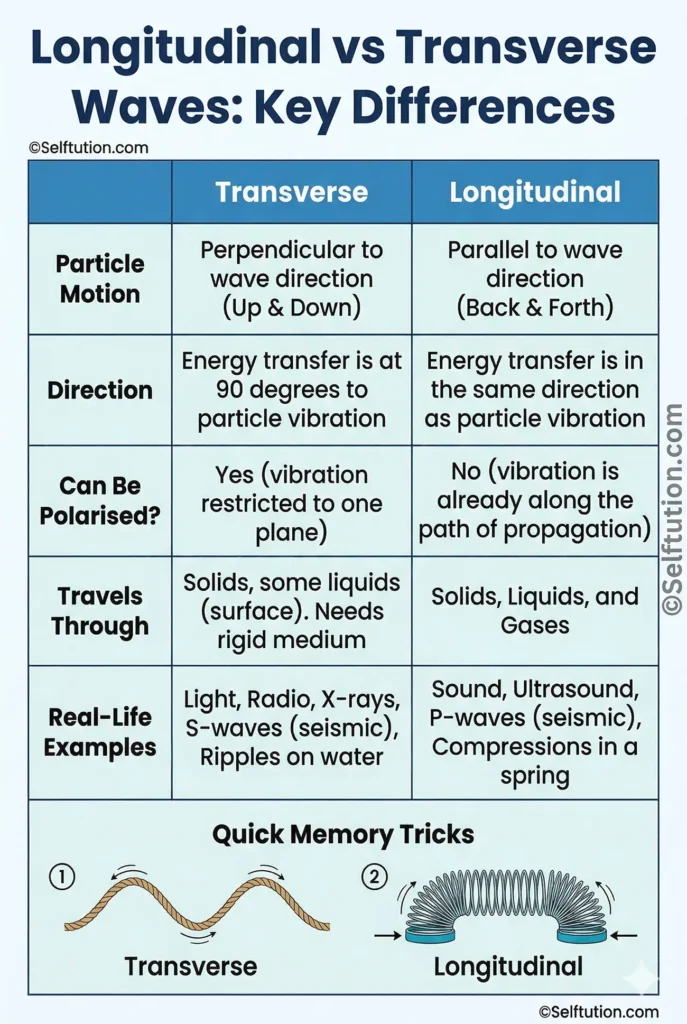
- Transverse waves: Particles move perpendicular (at 90 degrees) to the direction of wave travel.
- Longitudinal waves: Particles move parallel (back and forth) in the same direction as the wave travels.
Think of a transverse wave like shaking a rope up and down. The rope moves up and down, but the wave energy moves forward along the rope. As a result, the particle motion and wave motion are at right angles to each other. This is the defining feature of a transverse wave.
Longitudinal vs transverse waves overview
How Sound Proves That Longitudinal Waves Are All Around You
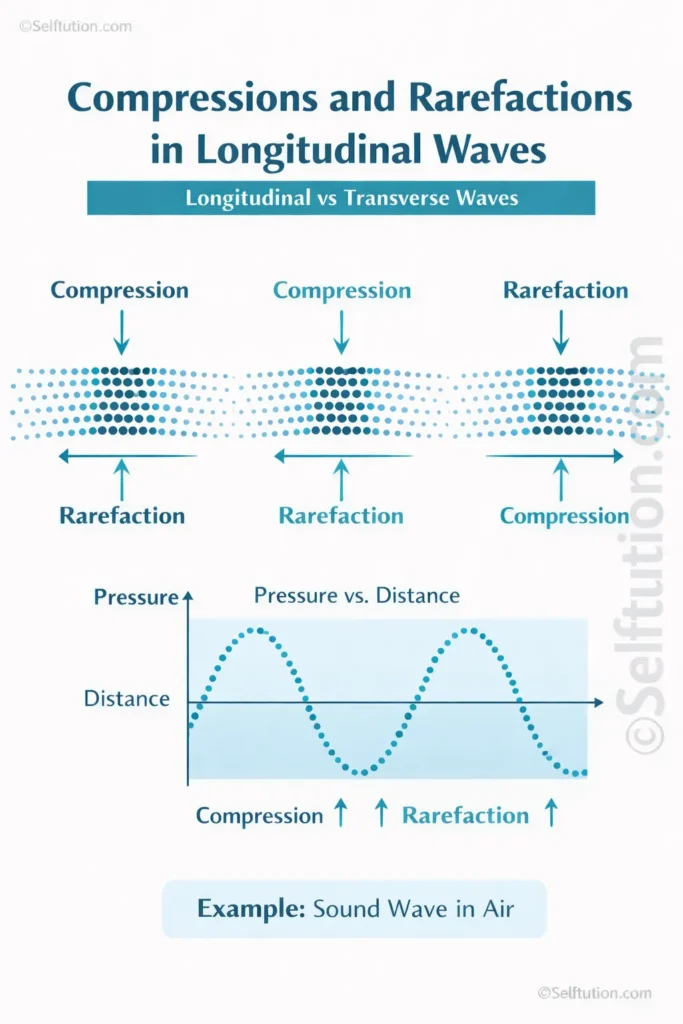
Sound is the most familiar example of a longitudinal wave. When you speak, your vocal cords vibrate and push air particles forward. Those air particles then push into the ones ahead of them, creating a series of compressions (areas where particles are squished together) and rarefactions (areas where particles are spread apart). This push-and-pull motion travels all the way to someone else’s ears.
Additionally, longitudinal waves can travel through solids, liquids, and gases. However, transverse waves in the form of mechanical waves can only travel through solids, because liquids and gases cannot transmit the sideways push that transverse mechanical waves need. Light, however, is a transverse wave that travels through space.
Longitudinal vs Transverse Waves: Real-Life Examples That Make It Click
Seeing real examples helps make the difference between longitudinal vs transverse waves concrete and memorable. Below are the most common examples you will encounter in your science class.
Transverse wave examples:
- Light waves (including all colours of visible light)
- Radio waves and microwaves
- Water surface waves (ripples on a pond)
- Waves on a guitar string
- Secondary seismic waves (S-waves) during earthquakes
Longitudinal wave examples:
- Sound waves in the air
- Ultrasound waves used in medical imaging
- Primary seismic waves (P-waves) during earthquakes
- Waves in a compressed spring (like a Slinky pushed end-to-end)
For instance, seismologists (scientists who study earthquakes) use both wave types together. Longitudinal P-waves arrive first because they travel faster. Transverse S-waves arrive second. Consequently, scientists can calculate the distance to an earthquake epicentre by measuring the time gap between the two wave types.
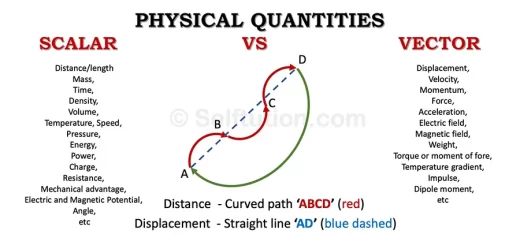
Waves connect closely to many other physics topics. To deepen your understanding, explore our guides on types of energy in physics, learn about rest and motion with examples, and read about types of motion in physics. You might also enjoy our articles on scalar and vector quantities, heat vs temperature, and Newton’s Laws of Motion.
Why the Direction of Particle Motion Changes Everything in Physics
The direction of particle motion determines how a wave behaves, how fast it travels, and what materials it can pass through. Therefore, this single difference has enormous practical consequences in science and technology.
Transverse waves can be polarised. Polarisation means the wave vibrations are restricted to one plane. For example, polarised sunglasses work by blocking transverse light waves vibrating in certain directions. This reduces glare from reflective surfaces like roads and water. Longitudinal waves, on the other hand, cannot be polarised because their particles already move in only one dimension, along the direction of travel.
Furthermore, understanding wave direction is critical in medicine. Ultrasound scans use longitudinal sound waves to create images of organs and babies before birth. The waves travel into the body, bounce off tissues, and return. A computer then converts the returning waves into a visible image. This technology is safe, painless, and incredibly useful.
Longitudinal vs transverse waves diagram showing compressions and rarefactions in sound wave
How to Remember Longitudinal vs Transverse Waves Every Time
Memory tricks make it much easier to keep longitudinal vs transverse waves straight in an exam. Here are two simple strategies that work brilliantly for students.
- The Rope Trick: Imagine holding one end of a long rope. If you shake it side to side, you create a transverse wave. The wave travels forward, but the rope moves sideways. If you could push and pull the rope in and out like a spring, that would be a longitudinal wave.
- The Letter L: “Longitudinal” starts with L. Think of an arrow pointing Left and Right, in the same direction the wave travels. For “Transverse”, the particles move across, or at a right angle. This visual cue sticks quickly.
Additionally, drawing a quick diagram in your notes always helps. A wavy sine curve represents a transverse wave beautifully. For a longitudinal wave, draw closely packed dots (compressions) alternating with widely spaced dots (rarefactions). Visual learners especially benefit from this approach.
Longitudinal vs transverse waves side-by-side comparison
For further reading from trusted academic sources, visit Khan Academy: Mechanical Waves and Sound and the Physics Hypertextbook on Waves.
Frequently Asked Questions About Waves
What is the main difference between longitudinal and transverse waves?
The main difference is particle direction. In transverse waves, particles move perpendicular to the wave direction. In longitudinal waves, particles move parallel to the wave direction, creating compressions and rarefactions.
Is sound a longitudinal or transverse wave?
Sound is a longitudinal wave. Air particles vibrate back and forth in the same direction that the sound travels. This is why sound needs a medium, such as air, water, or a solid, to travel through.
Can transverse waves travel through liquids?
Mechanical transverse waves generally cannot travel through liquids or gases because these states of matter cannot sustain sideways shear forces. However, light, which is an electromagnetic transverse wave, travels through liquids and even through space.
What are compressions and rarefactions?
Compressions are regions in a longitudinal wave where particles are pushed close together. Rarefactions are regions where particles are spread apart. Together, compressions and rarefactions form the repeating pattern of a longitudinal wave.
Why can light be polarised but sound cannot?
Light is a transverse wave, so its vibrations can be restricted to one plane. This is called polarisation. Sound is a longitudinal wave, and its particles vibrate along only one dimension already, so polarisation does not apply to sound.