International Court of Justice (ICJ) and United Nations
Understanding the relationship between the International Court of Justice (ICJ) and the United Nations is crucial for comprehending global governance.
This guide clarifies the ICJ’s role as the UN’s principal judicial organ, explaining its functions, jurisdiction, and how it upholds international law for a peaceful world order.
Welcome to Selftution.com, where we are dedicated to making complex topics like international law clear and simple to understand.
Now, let’s begin by exploring the foundation of the ICJ…
Welcome to our blog series on the United Nations and its key parts. Today, we’re diving into the International Court of Justice (ICJ), often called the world’s court.
This body helps solve big disputes between countries using rules and fairness. If you’ve ever wondered how nations settle arguments without fighting, the ICJ plays a big role.
Let’s explore what it is, how it started, and why it’s important in simple terms.
The United Nations, or UN, was established after World War II to maintain peace and promote international cooperation among countries. It has six main organs, each with a special job. Among them, the General Assembly stands out as one of the most important. It includes all member countries and discusses global issues like poverty, health, and rights.
The other organs are the United Nations Security Council, Economic and Social Council (ECOSOC), Trusteeship Council, Secretariat, and the International Court of Justice (ICJ). While the General Assembly represents everyone equally, the ICJ focuses on legal matters to ensure justice.
What is the International Court of Justice (ICJ)?

United Nations International Court of Justice (ICJ)
The International Court of Justice (ICJ) is the main court of the United Nations. It acts like a judge for the world, handling cases where countries disagree on laws or treaties. Unlike courts in your country that deal with people or companies, the ICJ only works with nations. For example, if two countries argue over borders or water rights, they can ask the ICJ for a decision.
Established in 1945, the ICJ is based in The Hague, a city in the Netherlands known as the peace capital. Its building, called the Peace Palace, is beautiful and symbolic. The court has 15 judges from different parts of the world, chosen for their knowledge of international law. These judges serve for nine years and can be re-elected.
Why is the ICJ part of the UN? Because the UN Charter, like a rulebook for the world, says the ICJ is its judicial organ. This means it helps enforce UN goals of peace and justice. Countries don’t have to follow ICJ rulings always, but most do because it builds trust.
History of the International Court of Justice (ICJ)
The story of the International Court of Justice (ICJ) goes back before the UN. In the early 1900s, people wanted a way to stop wars through talks and laws. In 1920, after World War I, the League of Nations created the Permanent Court of International Justice (PCIJ). This was the first global court, handling about 30 cases until World War II stopped it.
When the UN was formed in 1945, leaders knew they needed a better court. So, they replaced the PCIJ with the ICJ. The new court kept many old rules but improved them. Its first session was in 1946, and it has handled over 180 cases since then.
One key moment was in 1949, when the ICJ gave its first advisory opinion on reparations for UN staff injuries. This showed the court could help the UN itself. Over time, the ICJ has grown busier as more countries join the UN – now 193 members. Events like decolonization in the 1950s and 1960s brought many cases about independence.
The ICJ has faced challenges, too. During the Cold War, big powers like the US and the Soviet Union sometimes ignored rulings. But in recent years, with globalization, more nations have turned to the ICJ for fair solutions.
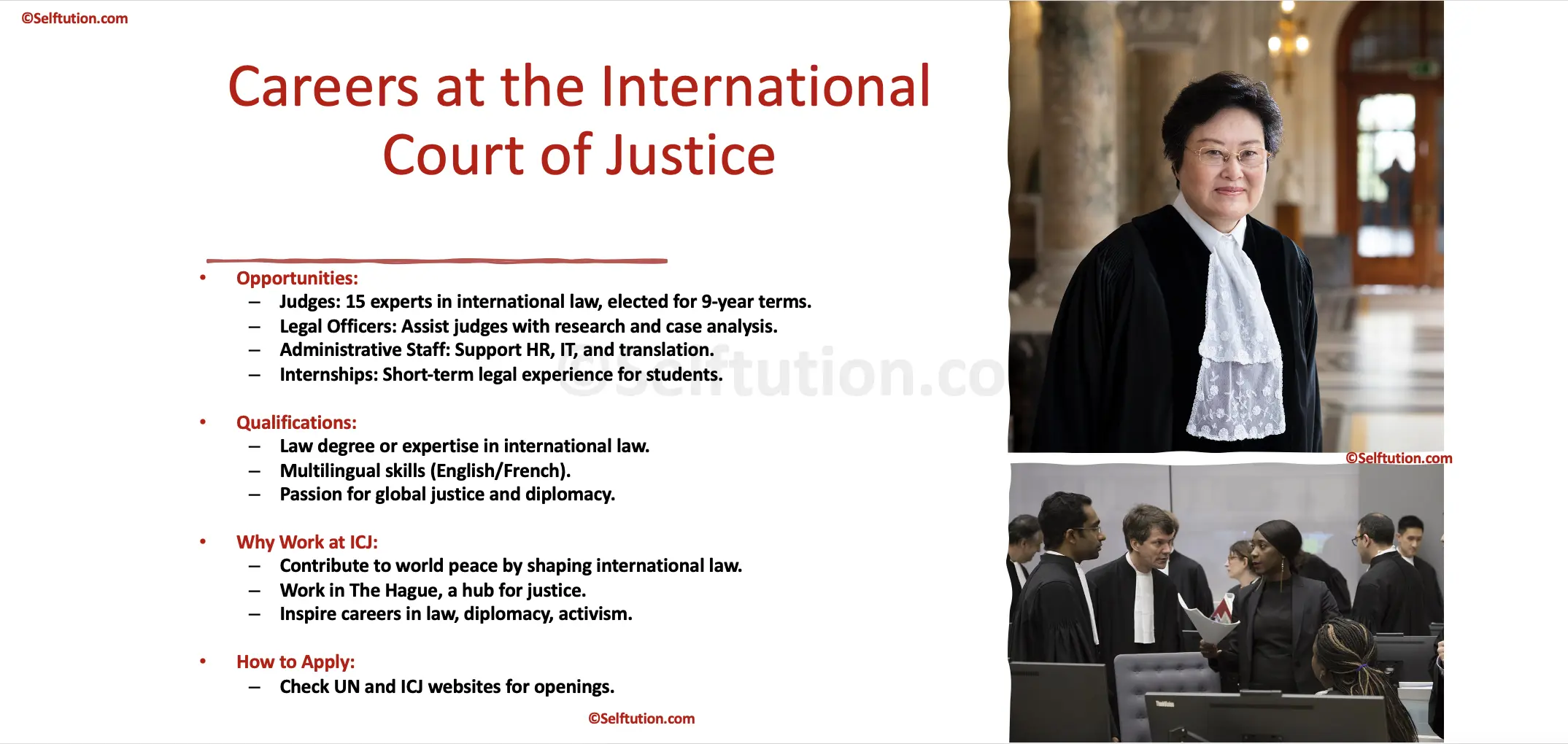
Careers and Jobs at the International Court of Justice (ICJ)
How the International Court of Justice (ICJ) Works
Understanding the workings of the International Court of Justice (ICJ) is like learning about a school debate but on a global scale. There are two main types of work: contentious cases and advisory opinions.
Contentious Cases at the International Court of Justice (ICJ)
These are like lawsuits between countries. A nation must agree to let the ICJ decide, either by signing a treaty or accepting the court’s power in advance. For instance, if Country A thinks Country B broke a fishing agreement, Country A files a case. Both sides present evidence, witnesses, and arguments. Hearings happen in public, and anyone can watch online now.
The judges discuss in private and vote on the decision. The ruling is final, and countries should follow it. If not, the UN Security Council can intervene, although this is rare.
Advisory Opinions from the International Court of Justice (ICJ)
These are not fights but requests for advice. Only UN organs or agencies can ask. For example, the General Assembly might seek the ICJ’s view on climate change laws. The opinion isn’t binding but guides actions. In 2024, the ICJ gave an opinion on Israel’s actions in Palestine, showing its role in hot topics.
Judges of the International Court of Justice (ICJ)
Who are these judges? They come from various continents to represent the world. No two can be from the same country. The UN General Assembly and Security Council elect them. Judges must be law experts, often former diplomats or professors.
To stay fair, judges can’t work on cases involving their own country. They wear black robes and speak French or English, the court’s languages.
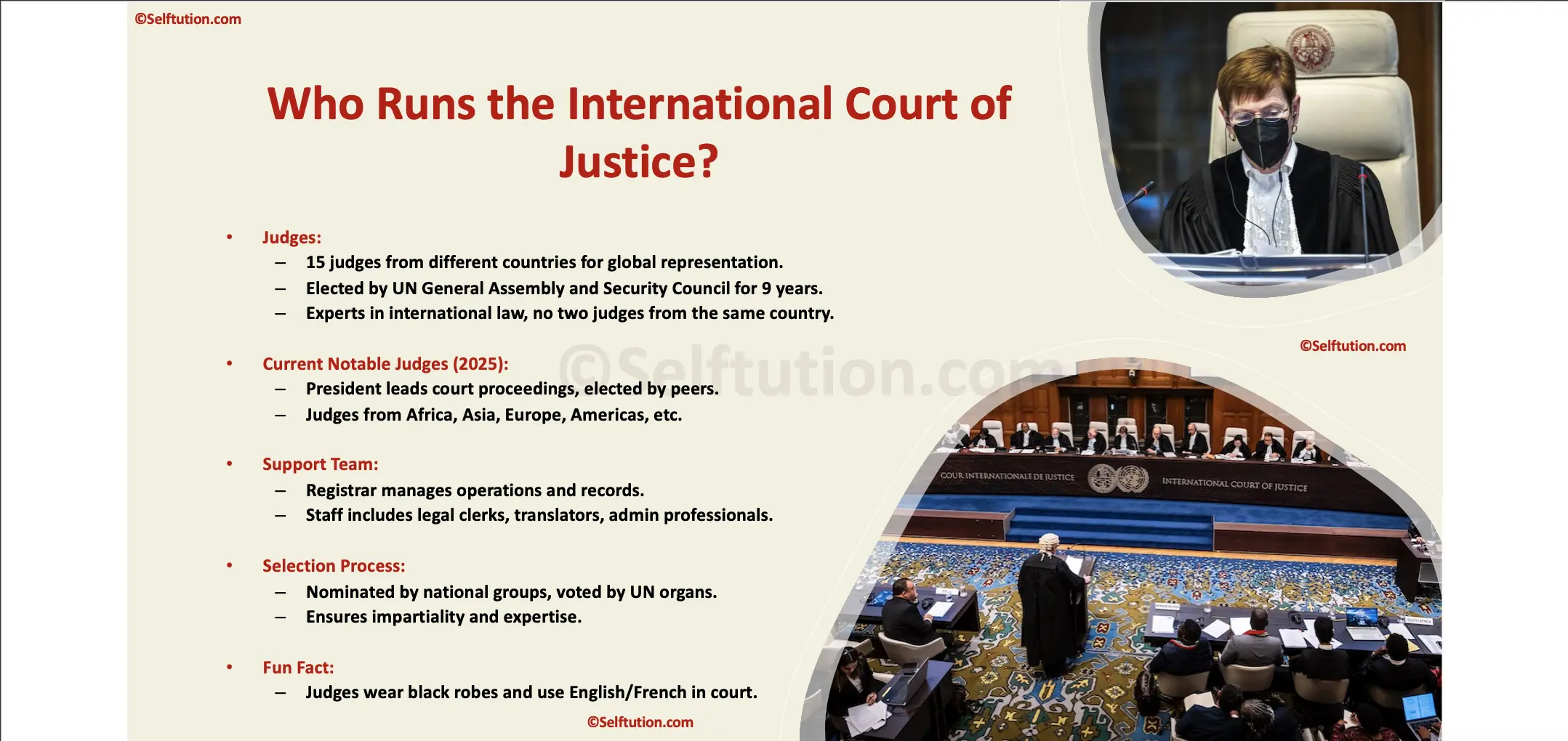
Members of the International Court of Justice (ICJ)
Famous Cases Handled by the International Court of Justice (ICJ)
The International Court of Justice (ICJ) has decided many important cases that shaped history. Let’s look at a few.
The Corfu Channel Case
In 1946, British ships hit mines in Albanian waters. The UK sued Albania, and the ICJ ruled Albania responsible. This was the first contentious case, setting rules for sea safety.
Nicaragua vs. United States
In the 1980s, Nicaragua accused the US of supporting rebels illegally. The ICJ said the US broke the law and should pay. Though the US didn’t fully comply, it highlighted that even powerful nations face judgment.
Whaling in the Antarctic
Australia took Japan to the ICJ in 2010 over whaling. The court ruled Japan’s program wasn’t scientific and ordered a stop. This protected ocean life and showed the ICJ’s environmental role.
More recently, cases on Ukraine vs. Russia over invasion claims and Gambia vs. Myanmar on Rohingya rights show the ICJ tackling human rights and wars.
These examples prove the International Court of Justice (ICJ) influences real-world changes, from borders to protecting people.
The Relationship Between the International Court of Justice (ICJ) and Other UN Organs
The International Court of Justice (ICJ) doesn’t work alone. It’s linked to the UN’s six main organs. As mentioned, the General Assembly is crucial – it elects ICJ judges and requests opinions. This makes the Assembly a voice for all nations in shaping justice.
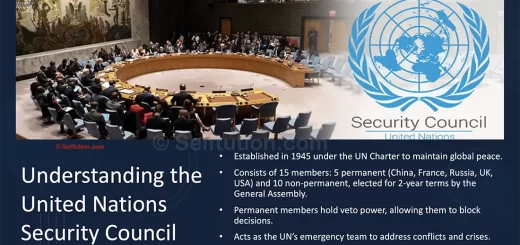
The Security Council also elects judges and can enforce rulings. For tougher issues like threats to peace, the Council might act on ICJ advice.
Then there’s the Secretariat, led by the Secretary-General, which handles UN admin work and supports the ICJ with research.
The Economic and Social Council deals with development and can consult the ICJ on legal matters in trade or health.
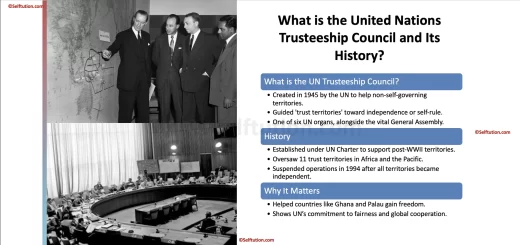
The Trusteeship Council, though less active now, once oversaw colonies and used the ICJ for disputes.
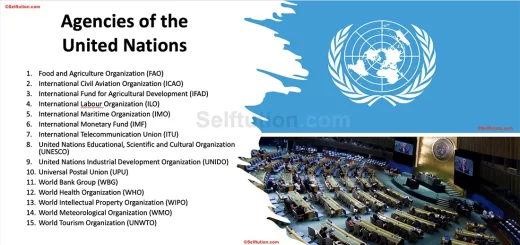
By understanding the ICJ, you see how it fits into the UN puzzle. If you want to learn more, check our other blogs on the Security Council for peacekeeping, the General Assembly for global debates, the Economic and Social Council for world improvement, the Trusteeship Council for past roles, and the Secretariat for daily operations. Together, they show the UN’s full picture.
Why the International Court of Justice (ICJ) Matters Today
In today’s world, with conflicts over climate, trade, and migration, the International Court of Justice (ICJ) is more relevant than ever. It promotes the rule of law, meaning everyone follows the same rules, whether big or small countries.
For young people, knowing about the ICJ inspires careers in law, diplomacy, or activism. It teaches that talking solves problems better than fighting.
Challenges remain, like slow processes or non-compliance. But reforms, like more judges or tech use, could help.
The ICJ also promotes global citizenship education. By following its cases, we learn about issues like sea level rise affecting islands, leading to ICJ cases.
Conclusion: Exploring More About the United Nations
We’ve covered the basics of the International Court of Justice (ICJ), from its start to its current impact. As the UN’s court, it upholds justice amid chaos.
Remember, the UN thrives on its six organs working together, with the General Assembly as a key player in unity.
Curious about the rest? Our blog on the General Assembly explains its voting power. Dive into the Security Council for veto stories, or the Economic and Social Council for sustainability tips. Don’t miss the Secretariat’s behind-the-scenes and the Trusteeship Council’s history.
Stay tuned for more, and share your thoughts in the comments. Peace starts with knowledge!
You may also like…... Types of Chemical Reactions in Chemistry