Nuclear Fission vs Fusion: The Ultimate Guide for Students
Nuclear fission vs fusion are two powerful ways in which atoms release tremendous energy. One splits heavy atoms apart, while the other joins light atoms together to make a new atom.
At Selftution.com, we break down complex science topics into simple and student-friendly explanations. Consequently, you can master physics effortlessly. Both reactions involve the atomic nucleus. However, they operate very differently.
What Is Nuclear Fission? Splitting Atoms
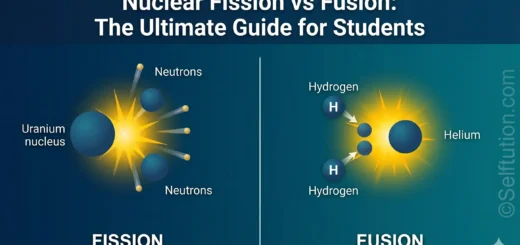
Nuclear fission happens when the nucleus of a heavy atom splits into two smaller nuclei. This process releases a massive amount of energy. Scientists use this energy to generate electricity in power plants globally.
Think of it like breaking a large cracker in half, except that you are breaking apart the core of an atom. Heavy elements like uranium are typically used as fuel.
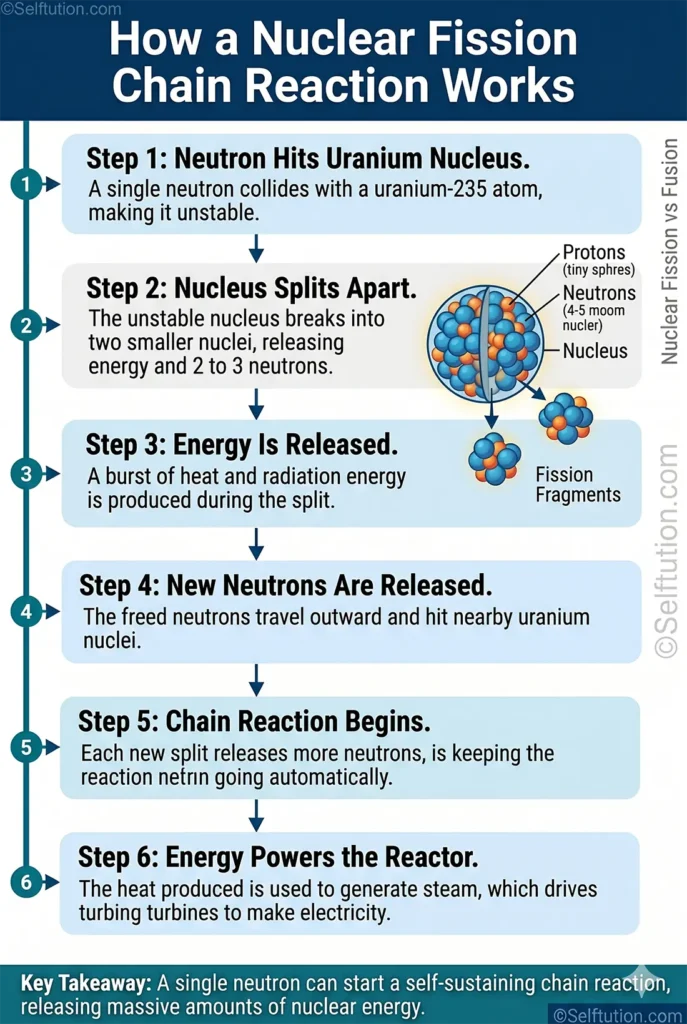
When the atomic nucleus splits, it also releases tiny particles called neutrons. These free neutrons then crash into other nearby nuclei. This continuous crashing causes a chain reaction. A chain reaction is a self-sustaining series of events. Therefore, each split triggers the next.
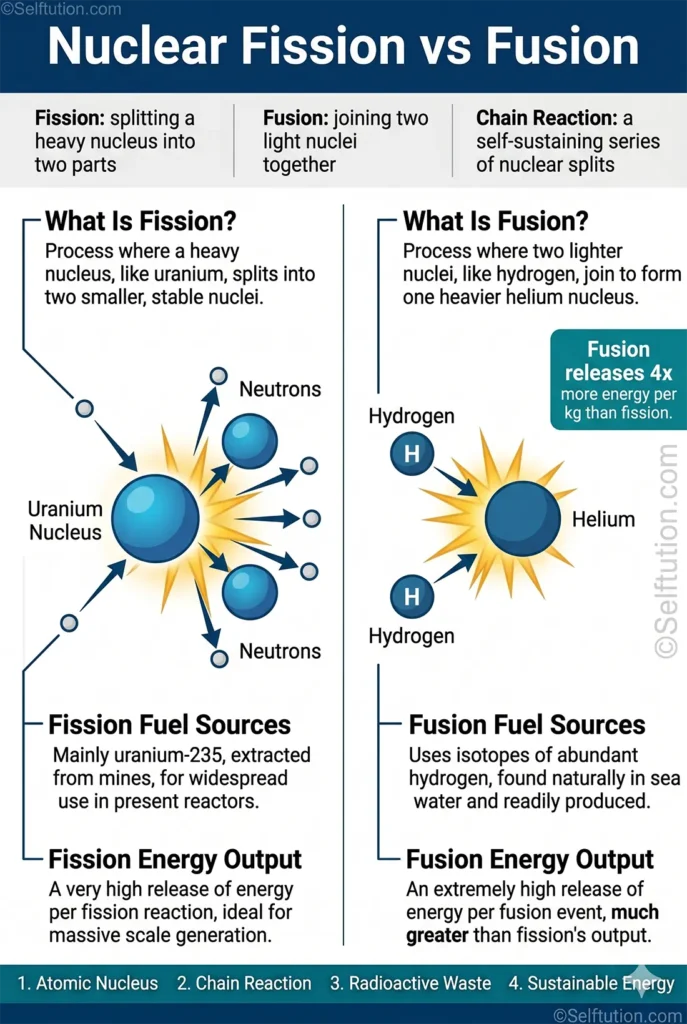
Nuclear fission vs fusion overview infographic
Here is a quick summary of the fission process. Firstly, it splits heavy atomic nuclei into smaller fragments. Secondly, it produces a large amount of energy quickly. Thirdly, it creates radioactive elements as a byproduct. Finally, it currently powers commercial nuclear reactors.
What Is Nuclear Fusion? Joining Atoms
Nuclear fusion is the exact opposite of fission. Instead of splitting apart, fusion joins two light atomic nuclei together to form one heavier nucleus. This incredible process releases even more energy than fission using the same amount of fuel.
The Sun is the most famous example of fusion in action. Inside the core, extreme pressure forces hydrogen nuclei together. They merge to form helium. Consequently, this reaction creates all the sunlight that makes life on Earth possible.
Scientists have been trying for decades to replicate this star power on Earth. Currently, controlled fusion is very difficult to achieve. It requires incredibly high temperatures reaching over 100 million degrees Celsius.
However, researchers are making exciting progress every year. Facilities are building giant magnetic devices to trap superheated plasma. You can learn more about how the universe uses forces in our guide on different forms of energy in physics.
Nuclear Fission vs Fusion: Key Differences
Understanding nuclear fission vs fusion is easier when you compare their specific traits side by side. Each method has unique requirements and outcomes.
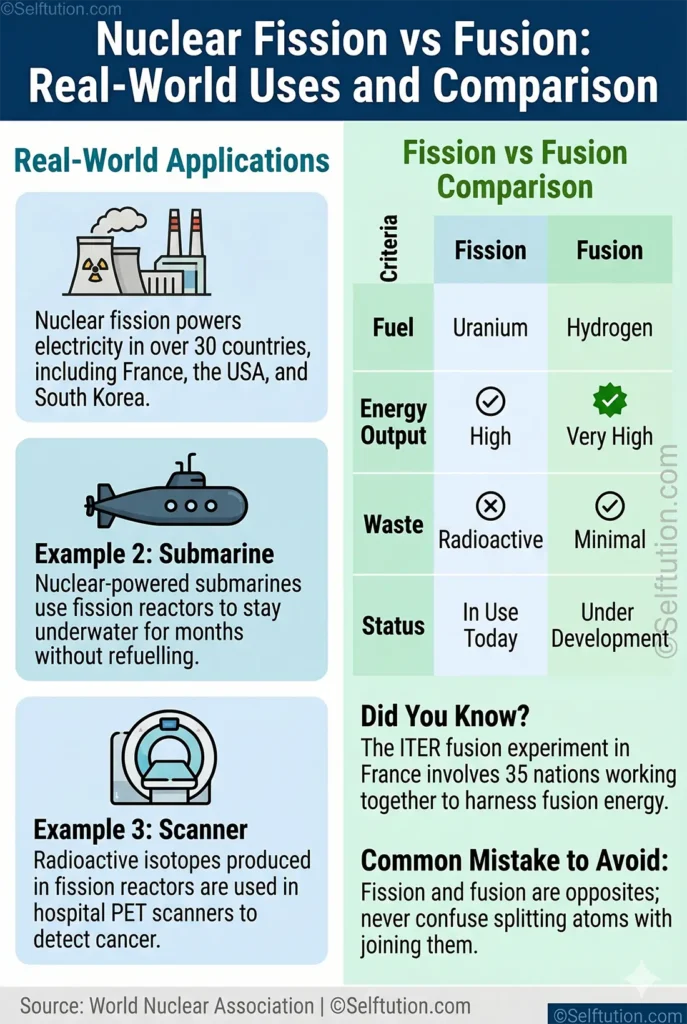
Fission uses heavy and unstable elements like uranium. Alternatively, fusion uses extremely light elements like hydrogen isotopes. Fusion is much more powerful overall. It releases nearly four times the energy per kilogram of fuel as fission.
Furthermore, fission produces long-lived radioactive waste that requires careful storage. Fusion produces helium and creates far less dangerous radioactive material.
Nuclear fission vs fusion real-world applications
Fission can occur at relatively normal operating temperatures inside a reactor. In contrast, fusion requires temperatures hotter than the center of the Sun. Fission is a proven technology used worldwide today. Meanwhile, fusion remains experimental and is not yet ready for commercial use.
Both methods tap into the immense power hidden inside atoms. However, they achieve this through opposite physical mechanisms.
Why Does Nuclear Fission vs Fusion Matter?
The ongoing debate around nuclear fission vs fusion highlights our need for sustainable energy. The world needs reliable electricity that does not pollute the air.
Scientists are incredibly excited about fusion technology. It could eventually provide clean and nearly unlimited power for the entire planet. The primary fuel for fusion is hydrogen. We can extract hydrogen easily from seawater. Therefore, it is an incredibly abundant resource.
Furthermore, fusion power plants would not release greenhouse gases. They also avoid creating long-lasting radioactive waste. These massive advantages make fusion the ultimate goal for future power generation.
On the other hand, fission is available right now. We already have the technology to build and operate safe fission reactors. Many nations use fission plants to heavily reduce their reliance on polluting fossil fuels. Fission plants generate massive amounts of electricity consistently.
For a deeper look into how power moves, read our article on the transformation of energy with examples.
The History Behind Nuclear Fission vs Fusion
The journey to understand nuclear fission vs fusion began over a century ago. Scientists in the early twentieth century were fascinated by the hidden structure of atoms.
In 1938, researchers made a groundbreaking discovery. They successfully split a uranium atom in their laboratory. Shortly after, physicists accurately explained the theoretical science behind this splitting process. This monumental achievement marked the official discovery of fission.
During the 1940s, researchers quickly realized that this chain reaction could produce massive amounts of power. Subsequently, scientists redirected their efforts toward peaceful power generation. By the 1950s, the world saw the construction of the very first commercial nuclear power plants. These facilities proved that humanity could harness atomic splitting safely.
Around the same time, astrophysicists finally solved the mystery of the stars. They realized that extreme gravitational pressure in the Sun caused hydrogen atoms to smash together. This realization birthed the modern pursuit of controlled fusion energy. You can learn more about the scientific history on the official Department of Energy website.
How Does a Nuclear Power Plant Work?
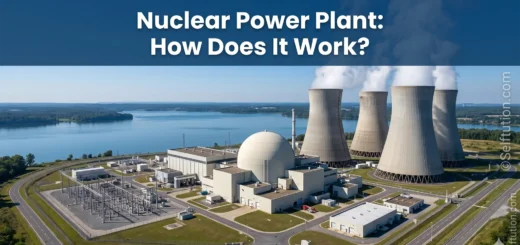
To truly understand the practical side of fission, it helps to look inside a working power plant. A modern nuclear facility is essentially a massive steam engine.
Inside the heart of the plant lies the reactor core. This heavily shielded vessel contains tall bundles of uranium fuel rods. When the chain reaction begins inside these rods, it generates immense amounts of pure heat.
Nuclear fission chain reaction step-by-step process infographic
Engineers pump cold water continuously around the hot fuel rods. The incredible heat from the atomic splitting boils the water instantly. Consequently, this boiling process creates high-pressure steam.
The rapidly expanding steam travels through thick pipes to reach a giant turbine. The force of the steam spins the heavy turbine blades at incredibly high speeds. The spinning turbine connects directly to an electrical generator.
As the generator spins, it produces the electricity that travels to your home. Finally, the steam flows into a cooling tower to condense back into water.
Safety and Environmental Risks
Safety is always a major concern when discussing any form of nuclear energy. Fission reactions naturally produce harmful radioactive elements as a waste byproduct.
These dangerous materials can remain radioactive for thousands of years. Engineers must store them securely deep underground to protect the environment.
Historical accidents at power plants have raised public fears. Events like Chornobyl demonstrated the severe risks of uncontrolled fission reactions. Modern reactors have significantly better safety systems to prevent such disasters.
Fusion is fundamentally much safer by design. A fusion reactor cannot melt down under any circumstances. It requires precise conditions to maintain the reaction constantly. If any system fails, the fusion reaction simply stops within seconds. Additionally, fusion does not produce the same highly dangerous waste.
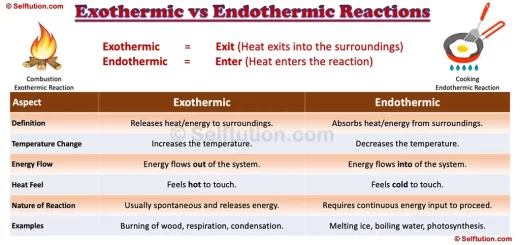
Explore related science topics like exothermic and endothermic reactions to understand heat transfer better.
Real World Applications of Both Reactions
Today, fission provides roughly ten percent of the total electricity generated globally. Nations value this technology as a steady alternative to traditional power sources.
Beyond civilian power grids, fission has critical military and medical applications. Nuclear-powered submarines use onboard fission reactors for propulsion. This allows them to stay submerged deep underwater for many months.
In the medical field, hospitals use specialized radioactive isotopes. Fission reactors produce these isotopes for doctors. Medical professionals then use them in hospital scanners to accurately detect diseases.
Fusion is not yet commercially viable for daily electricity. However, the scientific community has achieved massive milestones recently. In December 2022, scientists successfully produced net energy gain from a fusion experiment.
This means the reaction produced slightly more energy than the powerful lasers used to start it. To see how we calculate these incredible forces, check out our simple guide on work and energy in physics.
The Bigger Picture of Nuclear Fission vs Fusion
The story of atomic energy is a vital chapter in human history. We are constantly searching for better ways to power our growing civilization.
Understanding these advanced energy sources helps students grasp the massive scale of the universe. It shows us exactly how stars shine brightly. Furthermore, it reveals how humans can harness that same cosmic power safely.
Learning about fundamental concepts like gravitational force helps explain why atoms behave the way they do. The most important takeaway is that nuclear reactions change the atom itself.
Normal chemical reactions only rearrange the outer electrons. They never touch the dense core of the atom. This profound difference explains why splitting or joining atoms releases millions of times more energy. You can review different types of chemical reactions with examples on our website.
Frequently Asked Questions About Nuclear Fission vs Fusion
Q1: What is the main difference between nuclear fission and nuclear fusion?
Nuclear fission splits a heavy atomic nucleus into smaller pieces. Alternatively, nuclear fusion joins two light nuclei together. Both release energy, but fusion produces more total power.
Q2: Which method is safer for the environment?
Nuclear fusion is considered much safer overall. It cannot cause a runaway chain reaction. Furthermore, it generates far less long-lived radioactive waste compared to fission plants.
Q3: Is nuclear fusion available for everyday use yet?
Not yet. Fusion technology is still firmly in the research phase. Scientists hope that commercial fusion power plants might become a reality sometime after 2040.
Q4: Why does the Sun use nuclear fusion instead of fission?
The Sun consists almost entirely of hydrogen gas. Hydrogen is the perfect light fuel for fusion. The Sun lacks the heavy elements like uranium required to fuel a fission reaction.
Q5: How does this topic relate to my science class?
These concepts directly connect to the chemistry and physics topics you study. Learning about atomic structure helps you understand exactly how the modern world generates its electricity.