Characteristics of Sound Waves: A Complete Guide
The characteristics of sound waves shape every sound you hear. Understanding these properties helps you connect physics to your everyday experiences.
Furthermore, Selftution.com makes learning physics concepts like this enjoyable and straightforward, so students from Grade 6 to Grade 10 can build strong foundations quickly.
What Are the Characteristics of Sound Waves?
Sound is a form of energy that travels through a medium, such as air, water, or solid objects. It moves as a longitudinal wave, meaning the particles in the medium vibrate back and forth in the same direction as the wave travels. Furthermore, sound cannot travel through a vacuum, which is why outer space is completely silent.
To understand sound properly, scientists study five main characteristics of sound waves. These include frequency, amplitude, wavelength, speed, and timbre. Each property describes a different aspect of how a sound wave behaves in the physical world. Consequently, each one also directly affects how we perceive sound with our ears.
For a deeper look at how energy travels in different forms, visit Selftution’s guide on different types of energy in physics.
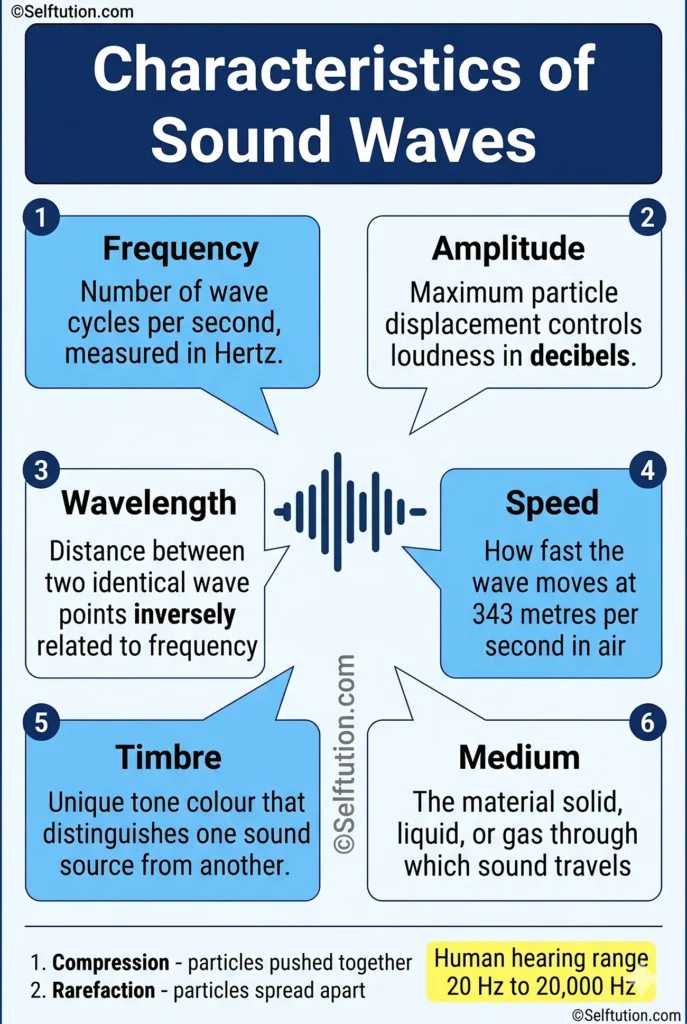
Overview infographic showing all 5 characteristics of sound waves, including frequency, amplitude, wavelength, speed, and timbre
How Frequency Acts as One of the Core Characteristics of Sound Waves
Frequency refers to the number of complete wave cycles that pass a given point in one second. It is measured in a scientific unit called Hertz (Hz). For example, if a wave completes 440 cycles in one second, its frequency is 440 Hz. This specific measurement is the musical note A used to tune instruments.
Additionally, frequency directly controls the pitch of the sound. A high-frequency sound has a high pitch, like a referee whistle or a bird call. In contrast, a low-frequency sound produces a deep, low pitch, like the rumble of thunder or the heavy beat of a bass drum.
The human ear can normally detect sounds between 20 Hz and 20,000 Hz. However, many animals have vastly different hearing ranges. Dogs can hear ultra-high frequencies up to 45,000 Hz, while elephants communicate using ultra-low frequencies that humans cannot detect. Therefore, when your music teacher tells you to sing a higher note, you are essentially being asked to produce a sound with a greater frequency.
Compression and Rarefaction Basics
Sound waves in the air create regions where particles crowd tightly together, called a compression. They also create regions where particles are spread wide apart, called rarefaction. These alternating pressure zones repeat continuously as the wave moves forward through the air. Moreover, the physical distance between two successive compressions equals exactly one wavelength.
You can visualise this physical process by pushing a coiled slinky toy along a flat table. The coils bunch up to show compression and stretch apart to show rarefaction in a repeating pattern. Similarly, sound waves push air particles together and pull them apart as the wave travels from the source to your ear. To learn more about how different wave types work, explore Selftution’s helpful article on longitudinal and transverse waves.
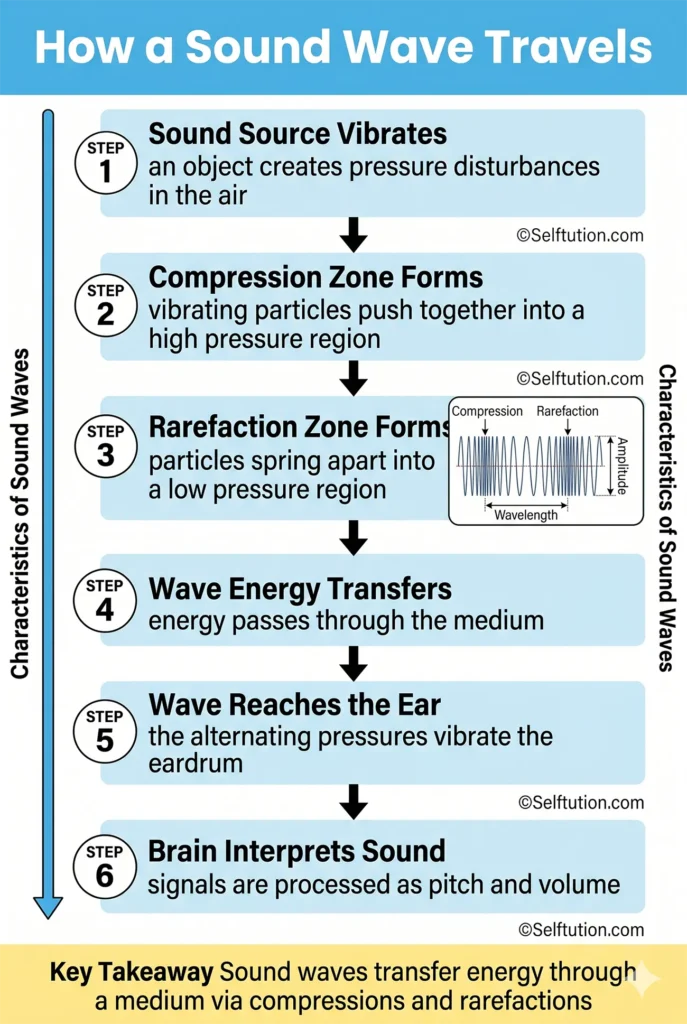
Step-by-step process infographic showing how characteristics of sound waves travel from the source to the ear through compression and rarefaction
Amplitude and Volume in the Characteristics of Sound Waves
Amplitude describes the maximum distance a particle moves from its resting position when a wave passes through. In simple terms, amplitude determines exactly how loud or soft a sound is. A large amplitude means the particles vibrate with greater energy, producing a much louder sound. Conversely, a small amplitude produces a quieter sound.
Sound amplitude is measured in a unit known as decibels (dB). For reference, a normal conversation measures around 60 dB, while a jet engine at close range can reach 140 dB, which actually causes physical pain. Additionally, sounds above 85 dB can damage your hearing over time. The Centers for Disease Control and Prevention provides excellent guidelines on how loud noises cause hearing loss if you want to protect your ears.
As a result, understanding amplitude is not just an academic exercise. It has real-world importance for your personal health and safety. Checking how measurement units work in science will help you read decibel charts and other scientific data with total confidence.
The Speed of Sound Explained
The speed of sound depends entirely on the physical medium it travels through. In dry air at room temperature, sound travels at approximately 343 metres per second. However, sound travels much faster through liquids and even faster through solid objects. This happens because the particles in denser materials are packed more closely together, allowing vibrations to transfer rapidly.
For example, sound travels roughly four times faster in water than it does in air. It travels about 15 times faster through solid steel. This scientific fact explains why you can sometimes hear a distant train approaching by placing your ear against the metal track long before you hear the noise through the air. Furthermore, temperature also significantly affects speed. Warmer air gives particles more energy, which causes sound to travel noticeably faster.
The National Aeronautics and Space Administration offers fascinating resources detailing how the speed of sound affects modern aviation and jet design. To understand how objects move and how physicists measure motion locally, take a look at types of motion in physics with examples on Selftution.
Wavelength as One of the Key Characteristics of Sound Waves
Wavelength is the physical distance between two identical points on consecutive cycles of a wave. You can measure this from one compression zone to the very next compression zone. Wavelength and frequency share a strict inverse relationship in physics. As frequency increases, wavelength automatically decreases, and vice versa.
Consequently, high-pitched sounds always have incredibly short wavelengths, while low-pitched sounds have very long wavelengths. Understanding the difference between scalar and vector measurements in physics will also strengthen your grasp of these wave properties. Visit Selftution’s page on scalar and vector physical quantities for a clear comparison.
Timbre and Tone Quality
Timbre is the unique quality or tone colour of a sound. It allows you to tell a piano apart from a guitar even when they play the same note at the same volume. Therefore, timbre explains why different musical instruments each produce a unique, recognisable sound.
It is determined by the complex mix of underlying frequencies present in any given sound. These hidden frequencies are called harmonics or overtones. Every single voice and instrument has a specific harmonic signature.
Real-Life Examples Showing the Characteristics of Sound Waves
Studying abstract wave properties becomes much easier when you connect them to things you see and hear every single day. Here are some highly relatable examples that demonstrate the science in action.
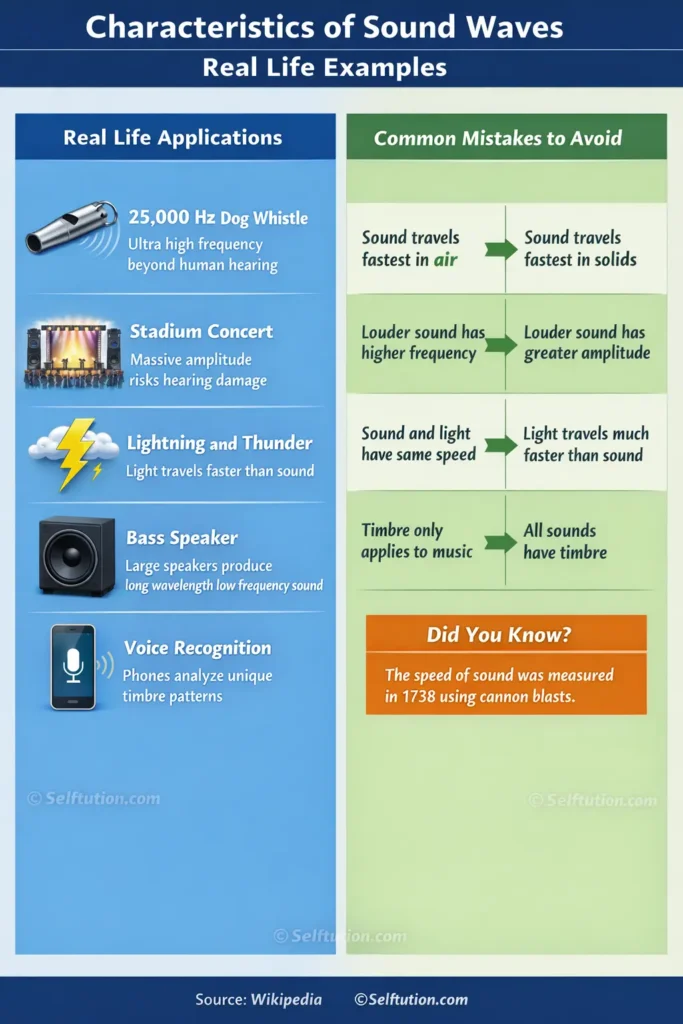
- Frequency in music: A dog whistle produces an ultra-high frequency around 25,000 Hz. Humans cannot hear it, but dogs can detect the sound easily.
- Amplitude at a concert: The roar of a massive crowd in a football stadium is louder than a whisper because the crowd produces sound waves with much greater amplitude.
- Speed of sound in nature: Lightning is always seen before thunder is heard because light travels millions of times faster than sound. The distance to a distant storm can be accurately estimated by counting the seconds between the visible flash and the audible thunder.
Real-life applications and common misconceptions about the characteristics of sound waves
Additionally, the concept of work and energy in physics connects directly to sound, since producing a louder sound requires significantly more physical energy.
For further reading from a trusted academic source, the Wikipedia article on Sound provides an in-depth overview of the science behind these wave properties.
A Quick Summary of These Concepts
Before diving into the frequently asked questions, here is a concise overview of everything we just covered.
- Frequency: Determines the pitch and is measured in Hz.
- Amplitude: Determines the overall loudness and is measured in dB.
- Wavelength: Represents the distance between two consecutive compressions.
- Speed: Dictates the rate at which sound travels through a given medium.
- Timbre: Provides the unique tone quality of a sound.
Furthermore, the characteristics of sound waves all interact closely with each other. Changing the frequency of a sound also instantly changes its wavelength. Similarly, the medium a sound travels through affects both speed and how clearly its characteristics are perceived by the listener.
Understanding distance and displacement in physics will also help you appreciate how wavelength is measured in strict scientific terms.
Characteristics of Sound Waves: Frequently Asked Questions
Q1: What are the main characteristics of sound waves?
The five main characteristics of sound waves are frequency, amplitude, wavelength, speed, and timbre. Frequency controls pitch, amplitude controls volume, wavelength is the physical length of one wave cycle, speed depends on the medium, and timbre gives each sound its unique quality.
Q2: How does frequency affect the pitch of a sound?
Frequency and pitch are directly connected. A higher frequency produces a higher-pitched sound, while a lower frequency produces a deeper sound. For example, a tiny flute produces high-frequency sounds, while a massive tuba produces low-frequency sounds.
Q3: Why does sound travel faster through solids than through air?
Sound travels faster through solids because the particles in a solid are packed much more tightly together than those in a gas. As a result, vibrations transfer from one particle to the next far more quickly in a solid medium such as steel compared to open air.
Q4: What is amplitude in sound, and why does it matter?
Amplitude is the maximum displacement of particles from their rest position when a sound wave passes through. It directly determines exactly how loud a sound is. A greater amplitude means more energy in the wave, which produces a significantly louder sound.
Q5: Can sound travel through a vacuum?
No, sound absolutely cannot travel through a vacuum because it requires a physical medium like a solid, liquid, or gas to propagate. In space, there is no medium, so sound waves have no particles to vibrate.