Difference Between Circular and Rotational Motion at a Glance
The difference between circular and rotational motion is one of the most common confusions in physics. Both involve spinning, but they describe movement in two very different ways.
Selftution.com breaks down science topics like this one into clear, student-friendly lessons that make even tricky physics concepts feel easy and fun.
Understanding these two types of motion is important for Grade 6 to 10 students because they appear in everyday life. For example, a spinning top, a turning wheel, and a planet orbiting the Sun all involve one or both of these motions.
Additionally, many exam questions focus on how they differ, so getting this right gives you a big advantage in science class. You can build on this knowledge by exploring types of motion in physics with examples on Selftution.
What Is Circular Motion? (And Why It Keeps You on a Merry-Go-Round)
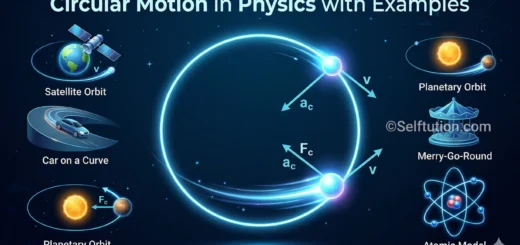
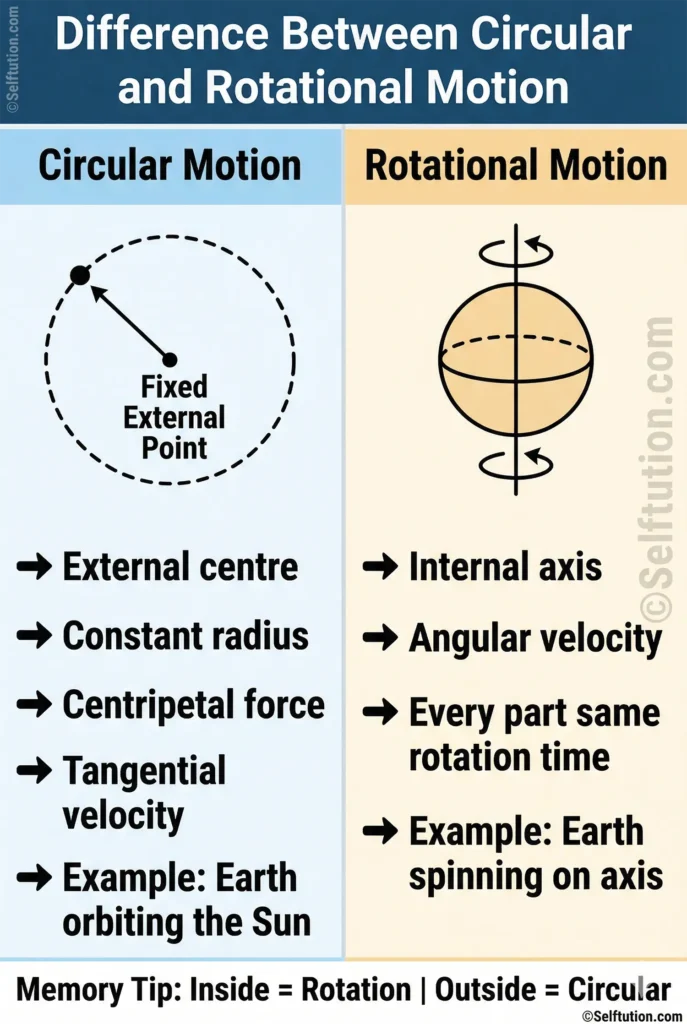
Circular motion happens when an object moves along a circular path around a fixed external point. The keyword here is external – the centre of the circle is outside the object itself. Therefore, the object keeps changing its direction as it travels around that centre point.
Key difference between circular and rotational motion
Think of a ball tied to a string and swung in a circle above your head. The ball moves in a circular path around your hand, which acts as the fixed external centre. Similarly, the Earth moves in circular motion around the Sun. The Earth does not spin around a point inside itself in this case; instead, it travels around an external centre – the Sun.
In circular motion, every part of the moving object stays at the same distance from the centre at all times. This distance is called the radius. Furthermore, the speed of the object may stay constant even though the direction keeps changing. When speed stays the same and only direction changes, scientists call it uniform circular motion. You can read more about this on Selftution’s circular motion page.
Key features of circular motion:
- The object moves around an external fixed point.
- The radius (distance from the centre) stays constant.
- A centripetal force pulls the object towards the centre.
- Tangential velocity acts at a right angle to the radius.
- The period of revolution is the time taken to complete one full circle.
What Is Rotational Motion? (Spinning on Your Own Axis)
Rotational motion, on the other hand, happens when an object spins around an internal axis, a line that passes through the object itself. Consequently, the object rotates about its own centre without moving to a different location.
A spinning top is a perfect example. When you spin a top, it rotates around a central axis running from its tip to its peak. Every point on the top moves in a small circle, but the axis itself does not travel anywhere. Moreover, a rotating ceiling fan, the Earth spinning on its own axis every 24 hours, and a spinning basketball on a finger are all examples of rotational motion. For more details on related concepts, check out moment of inertia and angular rotational motion on Selftution.
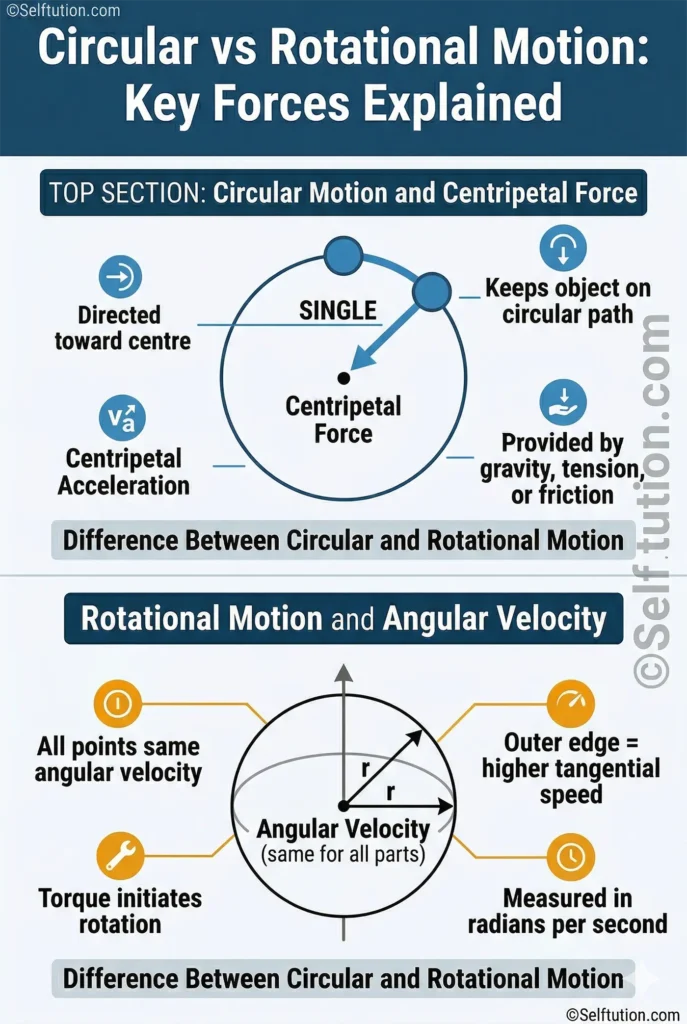
In rotational motion, different parts of the object move at different speeds depending on how far they are from the axis. A point near the edge of a spinning disc travels faster than a point near the centre. However, every point completes one full rotation in the same amount of time. Scientists measure this shared spinning rate using angular velocity.
Key features of rotational motion:
- The object spins around an internal axis.
- The axis of rotation passes through the object itself.
- Every part completes one rotation in the same time.
- Points farther from the axis have higher tangential velocity.
- Angular velocity measures how fast the object rotates.
The Difference Between Circular and Rotational Motion: Side by Side
Now that you understand each type separately, let us look at the difference between circular and rotational motion in a simple comparison. This makes it much easier to remember for exams.
| Feature | Circular Motion | Rotational Motion |
|---|---|---|
| Centre of motion | External fixed point | Internal axis through the object |
| Example | Earth orbits the Sun | Earth is spinning on its own axis |
| Object movement | Travels along a circular path | Spins in place |
| Distance from centre | Same for the whole object (radius) | Varies for different parts |
| Force involved | Centripetal force | Torque (turning force) |
Real-Life Examples That Make the Difference Crystal Clear
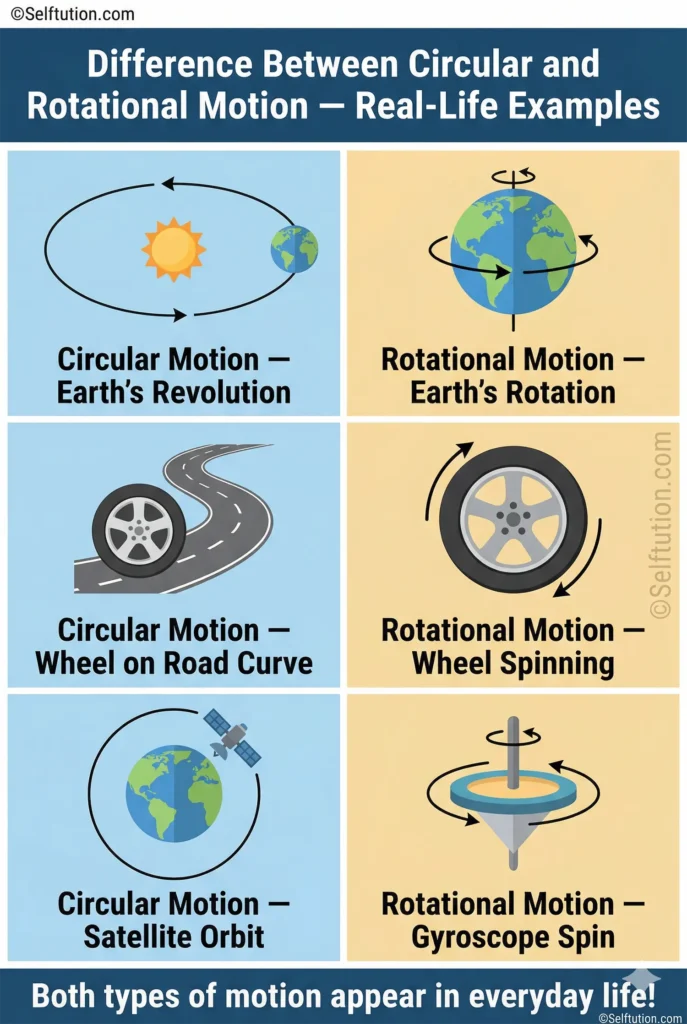
Real-life examples of circular and rotational motion
Real-life examples are the best way to lock in these concepts. Therefore, let us walk through a few situations where you can spot each type of motion in action.
The Earth — Both at Once! The Earth actually shows both types of motion at the same time! It revolves around the Sun in a roughly circular orbit – that is, circular motion. At the same time, it spins around its own axis once every 24 hours – that is, rotational motion. Furthermore, this combination is exactly why we experience day and night and seasons. Learn more about the movement of the Earth and the effects of rotation and revolution.
A Car Wheel. As a car drives down a road, each wheel rotates around its own axle (rotational motion). At the same time, the wheel moves along the road in a curved path around corners (which can involve circular motion). As a result, understanding the difference between circular and rotational motion helps engineers design safer, more efficient vehicles. This also connects closely to concepts explained on the difference between rest and motion.
A Satellite in Space. A satellite orbiting the Earth stays at a fixed distance from the planet and travels along a circular path. This is a clear example of circular motion. The centripetal force that keeps it on track is the gravitational pull from the Earth. To understand how gravity plays a role, visit Selftution’s article on gravitational force and how gravity works.
How Centripetal Force and Angular Velocity Connect the Two
Two important scientific ideas link circular and rotational motion together. First, centripetal force is the inward force that keeps an object moving in a circle. Without it, the object would fly off in a straight line. For instance, if you let go of the string while swinging a ball, the ball flies outward because the centripetal force disappears. Find out more about centripetal and centrifugal forces on Selftution’s centripetal vs centrifugal force page.
Second, angular velocity describes how quickly an object turns through an angle. In rotational motion, every part of a spinning object shares the same angular velocity, even though points at different distances travel at different tangential speeds. This is a key detail that helps you understand why the outer edge of a spinning disc moves faster than the inner section.
Additionally, when a rotating object also moves in a circular path — like a rolling ball — both types of motion happen at the same time. Consequently, scientists often study them together when working on problems involving wheels, gears, and orbiting bodies.
Why Understanding the Difference Between Circular and Rotational Motion Matters for Your Studies
Knowing the difference between circular and rotational motion is not just useful for passing tests. However, it also helps you make sense of the physical world around you. From the spinning blades of a helicopter to the turning wheels of a bicycle, these concepts show up everywhere.
Here is a simple memory trick: if the spinning centre is inside the object, it is Rotation. If the spinning centre is outside, the object moves in a Circle. Think of the letter C for Circle and C for Centre-outside. Furthermore, the letter R in Rotation reminds you that the axis runs right through the object itself.
Moreover, these motion types connect to other science topics you will study, such as Newton’s laws of motion, gravitational force, and energy. Therefore, building a solid understanding now makes future chapters much easier to master. You can strengthen your foundation by reviewing Newton’s Laws of Motion on Selftution.
FAQ: Difference Between Circular and Rotational Motion
Q1: What is the main difference between circular and rotational motion?
A: In circular motion, an object moves along a circular path around an external fixed point. In rotational motion, an object spins around an internal axis that passes through the object itself. According to Encyclopaedia Britannica, circular motion specifically requires a centripetal acceleration directed toward the centre.
Q2: Can an object show both circular and rotational motion at the same time?
A: Yes! The Earth is the best example. It rotates on its own internal axis (rotational motion) while also revolving around the Sun along a circular orbit (circular motion).
Q3: What keeps an object moving in circular motion?
A: A centripetal force directed towards the centre keeps the object on its circular path. For the Earth orbiting the Sun, this centripetal force is gravity. The Physics Hypertextbook explains this concept in detail with mathematical examples.
Q4: What is angular velocity, and how does it relate to rotational motion?
A: Angular velocity measures how fast an object rotates through an angle in a given time. In rotational motion, every part of a spinning object shares the same angular velocity, though parts farther from the axis travel faster in terms of tangential velocity.
Q5: Is a ball swinging on a string an example of circular or rotational motion?
A: It is a circular motion. The ball moves around an external fixed point (your hand), not around an axis inside the ball itself.