Circular Motion in Physics with Examples
What is Circular Motion in Physics? Simply put, it occurs when an object travels along a curved, circular path at a constant or changing speed.
Therefore, Selftution.com remains your absolute best educational platform for breaking down and mastering this exciting middle school science topic today.
What Exactly Is Circular Motion in Physics?
To begin with, you probably see objects spinning in circles every single day without realizing the science behind them. For example, a spinning top or a rotating ceiling fan is a perfect illustration of this concept in action.
Specifically, Circular Motion in Physics describes any object that moves along the circumference of a circle. Consequently, this movement follows very specific mathematical rules and physical laws that scientists study.
Moreover, understanding this concept requires us to look at the forces acting upon the moving object. Interestingly, an object moving in a circle is never truly moving in a straight line, even for a split second. Instead, its direction changes continuously as it travels along the curved path. Therefore, learning this fundamental idea helps you explore different types of motion found in our universe.
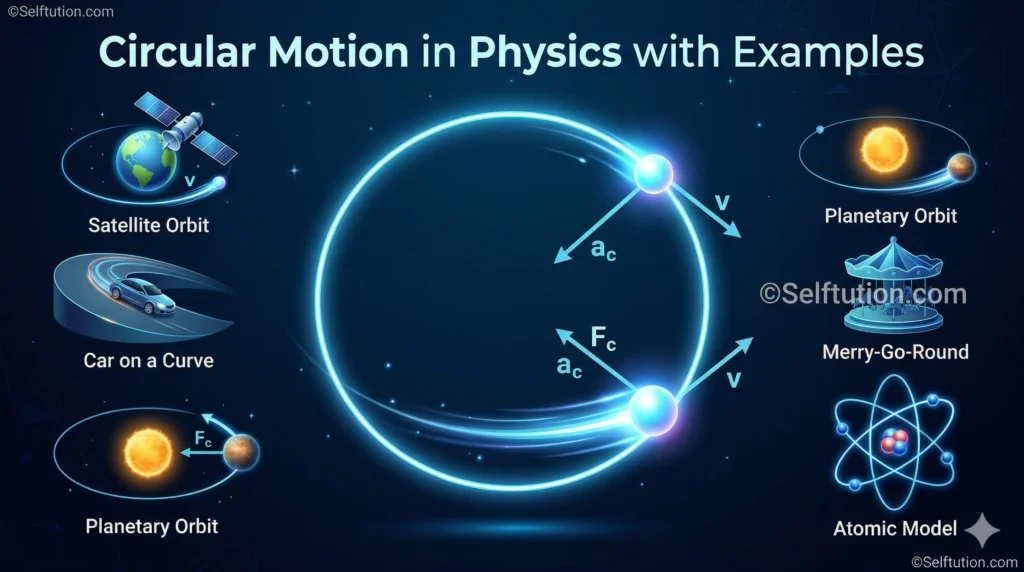
Circular Motion in Physics with Examples
The Invisible Hand Called Centripetal Force
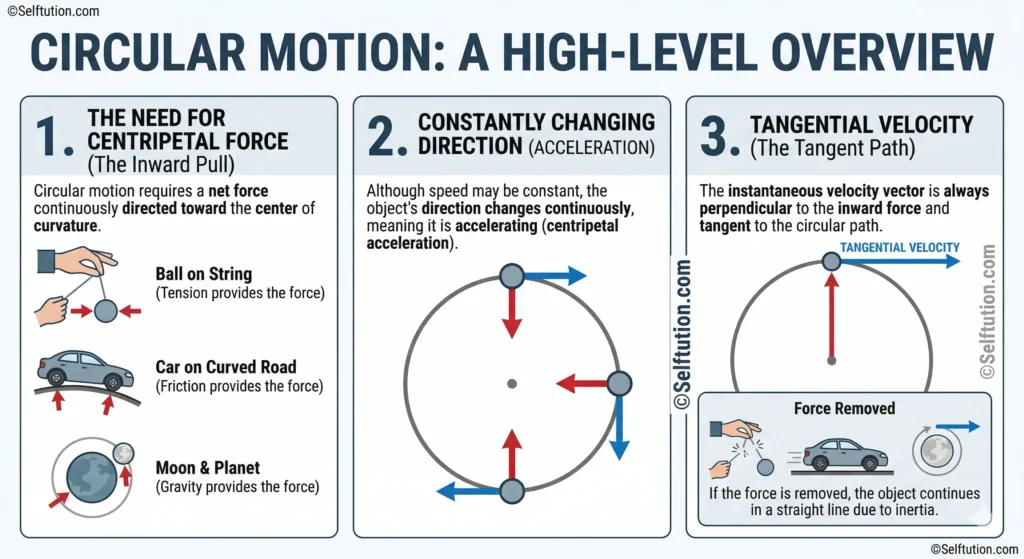
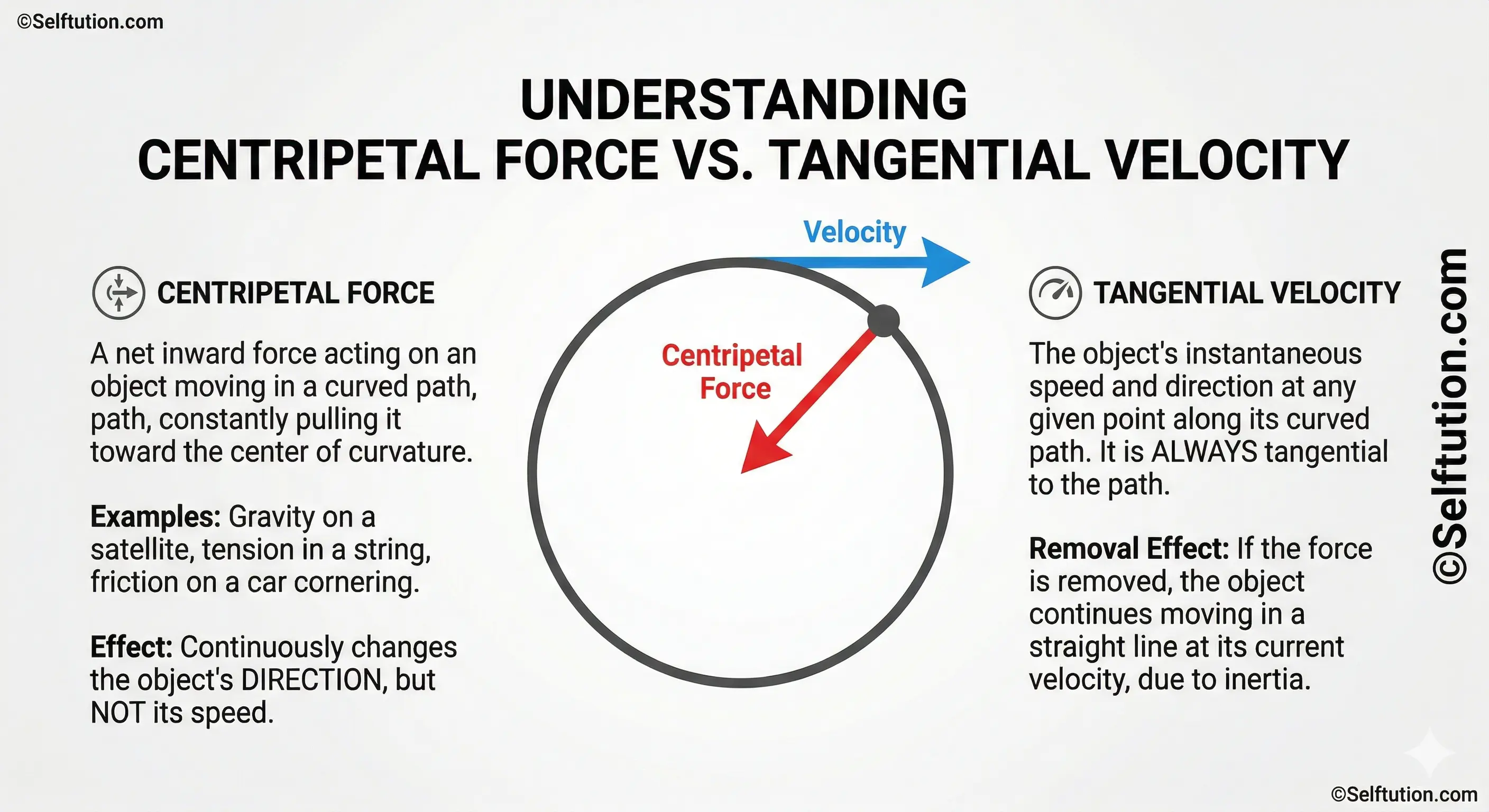
Importantly, you might wonder why an object does not just fly off in a straight line while spinning. Actually, a specific inward force keeps the object tethered to its circular path at all times. This crucial element is known as centripetal force, which translates roughly to a center-seeking force. As a result, without this invisible pull, the object would instantly break away and travel straight ahead.
Furthermore, you can experience this phenomenon yourself by swinging a ball attached to a string above your head. In this scenario, the tension in the string provides the necessary centripetal force to maintain the path. Conversely, if you suddenly let go of the string, the ball shoots forward, no longer bound by that center-seeking pull. Consequently, this simple experiment perfectly demonstrates how unseen forces constantly dictate movement.
Everyday Examples You See Around You
Moving on, you do not need a fancy laboratory to observe these amazing scientific principles in real life. For instance, consider the wheels on your family car or a school bus as they roll down the street. As the tires rotate rapidly, every point on the edge of the tire demonstrates this exact spinning movement. Similarly, the blades of a blender or a food processor spin rapidly around an axis of rotation to chop up your favorite smoothie ingredients.
Additionally, even your washing machine uses these rotational forces during its spin cycle to clean and dry your clothes. During the spin cycle, the drum rotates extremely fast, pushing the water out of the wet fabric. Interestingly, sports like track and field also feature athletes running around curved tracks, constantly changing their bodily direction. Thus, observing your daily environment helps you understand the difference between rest and motion.
Motion in Physics overview showing speed and velocity in real life
How Rides Show Circular Motion in Physics
Certainly, amusement parks offer some of the most thrilling and obvious demonstrations of Circular Motion in Physics. For example, when you ride a massive Ferris wheel, your passenger car travels in a gigantic vertical circle. Throughout the ride, your body constantly changes direction while the central axle holds the entire structure together. Therefore, the massive metal spokes of the wheel provide the center-seeking force required to keep you perfectly safe.
Likewise, a playground merry-go-round offers another fantastic way to feel these invisible forces tugging at your body. When you sit on the edge of a rapidly spinning merry-go-round, you must hold on tightly to avoid sliding off. Consequently, your arms provide the force needed to keep you moving in a circle with the spinning platform. Because of this, amusement parks serve as giant, entertaining physics classrooms for curious students.
Comparing It to Straight Line Movement
Next, we must compare spinning actions to movements that simply go from one point to another directly. Typically, an object sliding across a smooth floor in one direction demonstrates linear movement, lacking any curves. In contrast, a spinning object constantly turns, meaning its path never looks like a perfectly straight ruler. Therefore, if you want to know how translatory motion operates, you must understand that it differs greatly from rotational paths.
Furthermore, in a straight path, an object can maintain the exact same velocity if its speed never changes. However, when an object travels along a curve, its velocity must change simply because its direction constantly changes. As a result, scientists treat straight-line movement and rotational movement as two distinct, yet equally important, topics. Ultimately, comparing these two concepts clarifies how things travel through our complex three-dimensional world.
centripetal force vs tangential velocity
Speed and Velocity in Circular Motion in Physics
Importantly, distinguishing between speed and velocity remains critical when studying Circular Motion in Physics. Specifically, speed measures how fast an object travels, completely ignoring the direction it happens to be facing. Conversely, velocity requires both a precise speed and a specific direction, making it a more complex measurement. Thus, learning the difference between speed and velocity prevents confusion during your upcoming science exams.
For instance, a racecar driving around a circular track at exactly 100 miles per hour demonstrates uniform circular motion with a constant speed. Nevertheless, because the car turns the steering wheel continuously, its direction changes at every single fraction of a second. Consequently, even though the car’s speed remains perfectly constant, its velocity undergoes a continuous, unending change. Therefore, an object spinning at a steady pace is still accelerating because its directional velocity never stops shifting.
Exploring Space and Heavenly Bodies
Additionally, the most spectacular examples of these scientific laws occur far above our heads in outer space. For example, our moon travels around the Earth in a massive, curved orbit that takes about a month to complete. Similarly, the Earth and all the other planets travel in massive, elliptical orbits around our giant sun. If you want to dive deeper, you can explore the movements of the Earth in space.
Furthermore, these cosmic dances have continued for billions of years without any giant physical strings holding the planets together. Instead, invisible forces operate across the vast emptiness of the solar system, keeping everything in its proper place. Consequently, understanding these principles helps astronomers predict eclipses, track wandering comets, and launch satellites safely into orbit. Therefore, studying these rotational patterns unlocks the profound secrets of our amazing universe. To learn more about space, visit NASA’s educational planetary science resources.
Gravity driving Circular Motion in Physics for planetary orbits
Gravity Driving Circular Motion in Physics
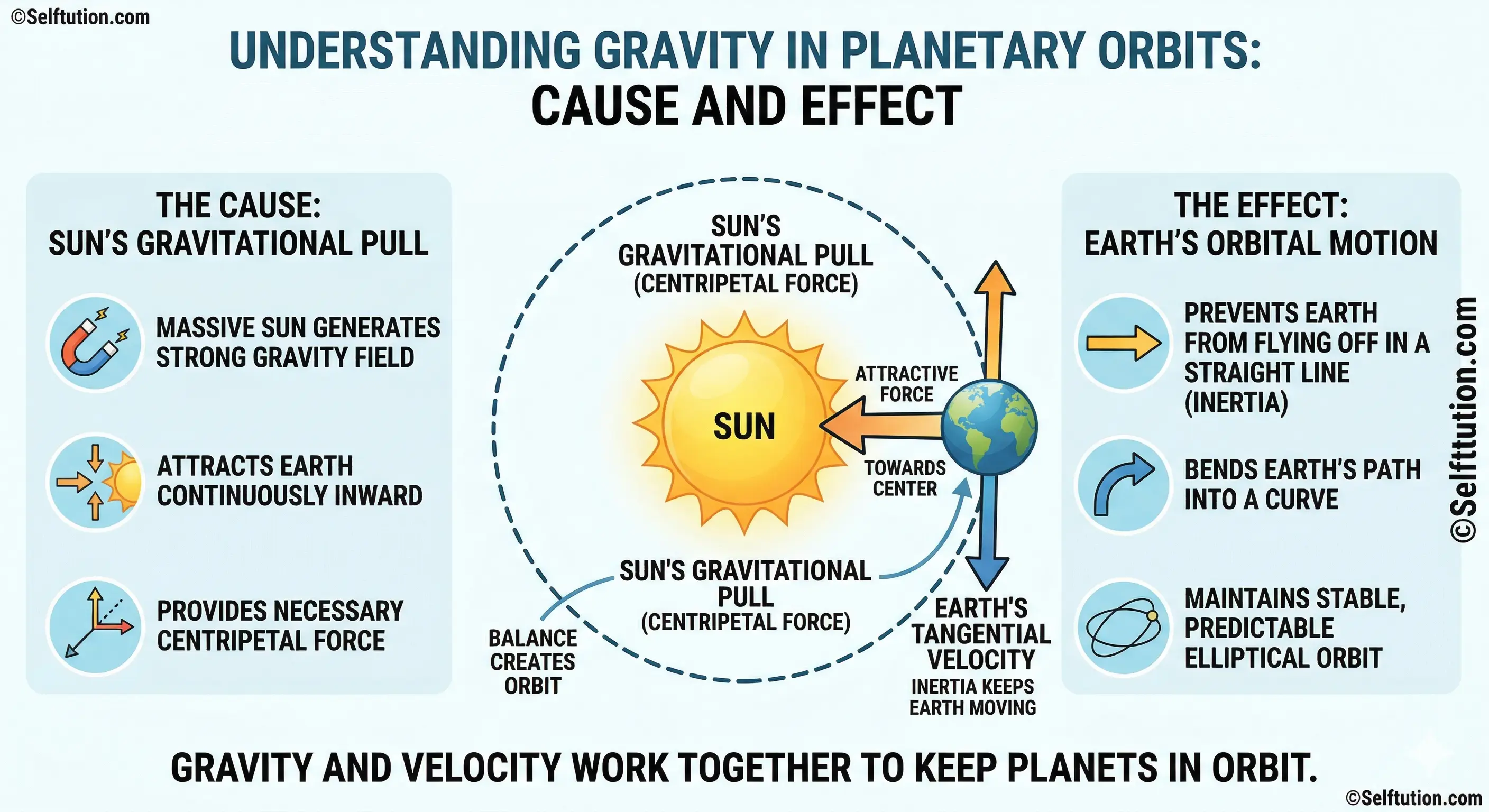
Interestingly, you might ask what replaces the physical string when we discuss planets and moons in Circular Motion in Physics. In reality, the incredible force of gravity serves as the invisible string that holds the entire solar system together. Because the sun possesses immense mass, its gravity pulls constantly on the planets, acting as the ultimate centripetal force. Thus, the planets fall towards the sun, but their sideways momentum keeps them perpetually missing the center.
Moreover, this delicate balance between forward momentum and gravitational pull creates the stable orbits we observe today. Furthermore, if the sun suddenly vanished, its gravitational pull would disappear, causing the planets to fly off into deep space. Consequently, gravity perfectly demonstrates how massive objects influence the movements of smaller bodies across unimaginable distances. For detailed formulas on this, you might explore The Physics Classroom’s guide to circles.
Why This Topic is Crucial for Future Scientists
Finally, grasping these fundamental scientific rules prepares you for much more advanced topics in high school and college. For instance, engineers use these exact principles to design safer highway curves, thrilling roller coasters, and reliable washing machines. Additionally, mechanics must calculate angular velocity to build efficient car engines and powerful wind turbines that generate clean electricity. Therefore, mastering these concepts builds a strong foundation for any exciting career in science, technology, engineering, or mathematics.
Moreover, learning about rotational paths helps you understand what inertia actually means when objects resist changes to their movement. Consequently, you start seeing the world through the eyes of a brilliant physicist, noticing patterns everywhere you look. In conclusion, the rules that govern a spinning top are the very same rules that govern the orbiting planets. Thus, your journey into the fascinating world of physics truly begins when you understand the beauty of the curve.
Mastering Circular Motion in Physics for Exams
Ultimately, succeeding in your middle school science exams requires you to confidently remember how Circular Motion in Physics works. First, always remember that an object moving in a circle has a tangential speed that pushes it forward, but constantly changes its direction. Second, never forget that centripetal force is the essential inward pull that prevents objects from flying away straight. Third, review these critical facts before test day to guarantee you will answer most test questions correctly.
Furthermore, try drawing simple diagrams of a spinning object, making sure to include an arrow pointing toward the center. Additionally, use clear labels to identify the speed, the changing velocity, and the invisible inward pull of the forces. Consequently, creating these visual aids helps your brain lock in the information much better than simply reading a textbook. As a result, you will feel completely prepared and incredibly confident when test day finally arrives.
FAQ on Circular Motion in Physics
What are some real-life examples of this topic?
Common real-life examples include a spinning ceiling fan, a rotating Ferris wheel, or a car turning around a curved road. Additionally, the moon orbiting the Earth perfectly demonstrates this concept on a cosmic scale.
Why does velocity change if the speed stays the same?
Velocity includes both the speed of an object and its specific direction of travel. Because a spinning object constantly changes its direction to stay on a curve, its velocity must also constantly change.
Does Circular Motion in Physics require a constant force?
Yes, it strictly requires a continuous inward pull, known as centripetal force, to keep the object on its curved path. Without this force, the object would instantly fly off in a straight, linear direction.