United Nations Security Council: Roles and Objectives
United Nations Security Council (UNSC): Key Roles, Objectives & Global Impact | Selftution.com
Discover the critical functions, powers, and objectives of the UNSC – explained with clarity and depth.
At Selftution.com, we break down complex international relations topics into simple, learner-friendly insights.
Welcome to the best educational website for mastering subjects that shape our world!
The United Nations is like a big global family meeting place where countries come together to solve problems.
It has six main organs that help it work, and one of the most important is the General Assembly (UNGA), where all member countries can vote and discuss issues equally.
But today, we’re diving into another key part: the United Nations Security Council. This council focuses on keeping peace around the world.
In this blog, we’ll explore what it does, how it works, and why it matters.
If you’re curious about the other organs, like the Economic and Social Council that handles money and people issues, or the International Court of Justice that settles legal fights between countries, check out our related blogs for more details.
What is the United Nations Security Council?
The United Nations Security Council is one of the main groups in the UN that deals with threats to peace. It was set up in 1945, right after World War II, to make sure big wars don’t happen again.
Imagine it as the UN’s emergency response team – when there’s trouble between countries, like fights or invasions, this council steps in.
The idea behind it comes from the UN Charter, which is like the rulebook for the whole organization. The council has 15 members in total. Five of them are permanent: China, France, Russia, the United Kingdom, and the United States. These are the big powers that won World War II, and they have a special power called the veto. That means if any one of them says no to a decision, it can’t happen. The other 10 members are elected for two-year terms by the General Assembly, and they represent different parts of the world to keep things fair.
Why is this structure important? It makes sure that powerful countries are always involved, but it also gives smaller nations a voice from time to time. For students learning about global affairs, think of it like a school council where some senior students have more say, but everyone gets a turn.

What is the United Nations Security Council (UNSC)?
How Does the United Nations Security Council Work?
Membership and Selection
Getting into the United Nations Security Council isn’t easy for the non-permanent spots. Countries campaign for votes in the United Nations General Assembly, which is an important organ where every UN member has one vote. The elected members serve for two years and can’t be re-elected right away, so new countries get a chance. This rotation helps spread influence.
The permanent members, or P5 as they’re often called, stay forever. They were chosen because of their role in winning the war and their military strength. But times have changed, and some people argue that countries like India, Brazil, or Germany should join as permanent members too. Reforms are talked about, but changing the council is tough because the P5 have to agree.
Meetings and Decisions
The United Nations Security Council meets whenever there’s a crisis, sometimes even in the middle of the night. Their headquarters are in New York, at the UN building. Decisions are made by voting: at least nine members must say yes, and none of the P5 can veto for important actions like sending peacekeepers.
They pass resolutions, which are like official orders. These can tell countries to stop fighting or impose rules. If a country ignores them, the council can take stronger steps. It’s all about talking first, then acting if needed.
Key Roles of the United Nations Security Council
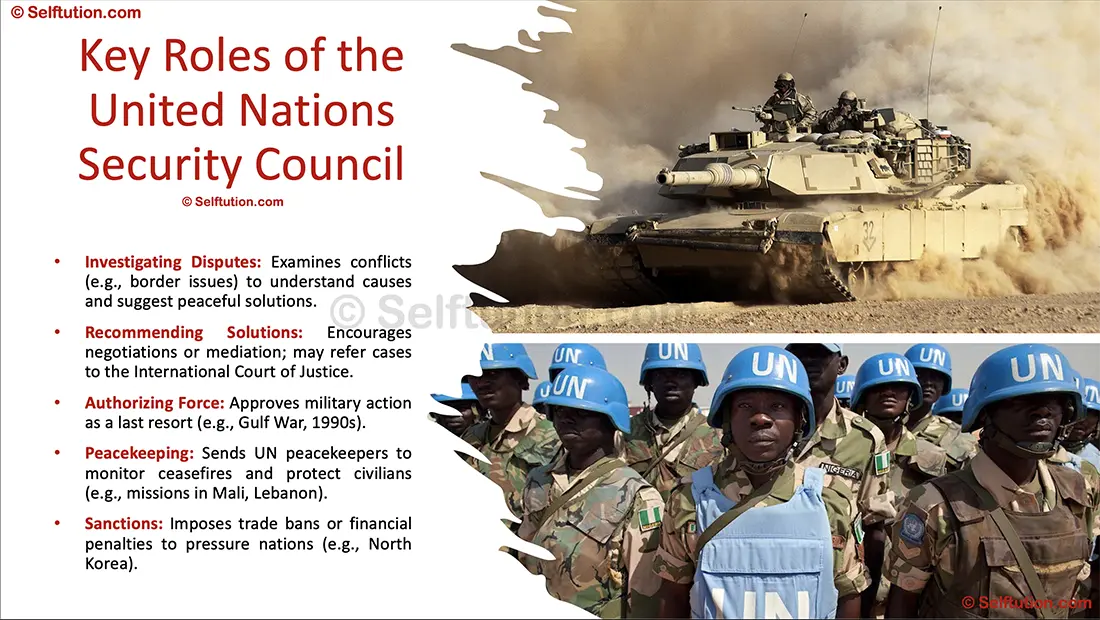
The main job of the United Nations Security Council is to maintain international peace and security. That’s their number one role, as written in the UN Charter. They watch for any signs of trouble, like border disputes or terrorist threats, and try to fix them before they get worse.
Investigating Disputes
One role is to look into problems between countries. If two nations are arguing over land or resources, the council can send investigators or hold hearings. This helps understand the facts and suggests ways to talk it out peacefully. For example, they’ve looked into conflicts in places like the Middle East or Africa many times.
Recommending Solutions
The United Nations Security Council doesn’t just point out problems; it offers fixes. They might suggest negotiations, where countries sit down and chat, or mediation, where a neutral person helps. In serious cases, they can recommend going to the International Court of Justice – that’s another UN organ we cover in a separate blog. Linking to that, understanding the court helps see how the council focuses on action while the court handles laws.
Authorizing Force
Sometimes, talking isn’t enough. The council can approve using military force if a country is attacking another. This is rare and only as a last resort. They’ve done this in places like Korea in the 1950s or Iraq in the 1990s. But they prefer peaceful ways first.
Roles of the United Nations Security Council (UNSC)
Objectives of the United Nations Security Council
The objectives of the United Nations Security Council are all about making the world safer and fairer. First, they aim to prevent wars by encouraging countries to solve issues without fighting. This ties back to the UN’s big goal of saving future generations from war, as said in the Charter.
Another objective is to promote human rights and justice. While the United Nations General Assembly discusses these broadly – and it’s one of the most vital organs for that – the council steps in when rights violations threaten peace, like in cases of genocide.
They also work on disarmament, trying to reduce weapons like nuclear bombs. Objectives include stopping the spread of dangerous arms and encouraging treaties. Plus, they fight terrorism by coordinating global efforts against groups that cause harm.
Looking ahead, the council’s objectives evolve with new challenges, like cyberattacks or climate conflicts. Their goal is to adapt and keep peace in a changing world.
Peacekeeping and Sanctions: Tools of the United Nations Security Council
Peacekeeping Missions
A big way the United Nations Security Council achieves its roles is through peacekeeping. These are missions where UN soldiers, called blue helmets, go to troubled areas to keep fighters apart and help rebuild. The council approves every mission, and there have been over 70 since 1948. Places like Cyprus, Mali, and Lebanon have seen these forces.
Peacekeepers don’t fight wars; they monitor ceasefires and protect civilians. This shows the council’s objective of long-term stability, not just quick fixes. Students might find it interesting that these missions involve troops from many countries, teaching cooperation.
Imposing Sanctions
When words fail, the UNSC uses sanctions. These are punishments like banning trade or freezing money to pressure bad actors. For instance, they’ve sanctioned North Korea over nuclear tests or Iran in the past.
Sanctions aim to change behavior without war. They’re carefully designed to hit leaders, not ordinary people, though sometimes it’s hard. This tool links to the Economic and Social Council, which deals with the fallout on economies – read our blog on that organ to see the full picture.

Objectives of the United Nations Security Council (UNSC)
Achievements of the United Nations Security Council
The United Nations Security Council has had big wins. It helped end the Cold War tensions by mediating between the superpowers. In the 1990s, it authorized actions that stopped invasions in the Gulf. More recently, it set up tribunals for war crimes in Yugoslavia and Rwanda, promoting justice.
Peacekeeping has saved countless lives, and resolutions on women in peace processes have advanced equality. Despite criticisms, the council has prevented many escalations into full wars.
Challenges Facing the United Nations Security Council
No group is perfect, and the United Nations Security Council faces issues. The veto power can block action, like in the Syrian conflict, where Russia vetoed resolutions. This makes some say it’s outdated.
Reform is a hot topic: expanding permanent members or limiting vetoes. Also, with rising powers in Asia and Africa, representation needs updating. Climate change and pandemics are new threats that don’t fit old ways.
Yet, the council keeps adapting, working with the Secretariat – the UN’s administrative arm, which we explore in another blog – to implement decisions.
How the United Nations Security Council Connects to Other UN Organs
The United Nations Security Council doesn’t work alone. It reports to the General Assembly annually, showing how that key organ oversees everything. For economic sanctions, it coordinates with the Economic and Social Council to minimize harm to people.
Legal matters go to the International Court of Justice, while the Trusteeship Council, though less active now, once handled territories under UN watch. The United Nations Secretariat provides staff and information for council operations.
To deepen your knowledge, our blog series covers each organ. Start with the General Assembly to see the UN’s democratic heart, then move to the Economic and Social Council for development topics. Don’t miss the International Court of Justice for justice stories, the Trusteeship Council for history, and the Secretariat for behind-the-scenes work. Together, they paint the full UN picture.
Wrapping Up: Why the United Nations Security Council Matters Today
In a world full of uncertainties, the UNSC stands as a guardian of peace. Its roles in investigating, recommending, and acting, plus objectives like preventing wars and promoting rights, make it essential. While challenges exist, its achievements show hope.
For students, understanding this council helps them grasp global news. Remember, it’s part of a bigger UN family, with the United Nations General Assembly as a standout organ among the six. Explore our other blogs to connect the dots and become a global citizen.
You may also like…... Types of Chemical Reactions in Chemistry